Digital programme booklet
-
Featuring:
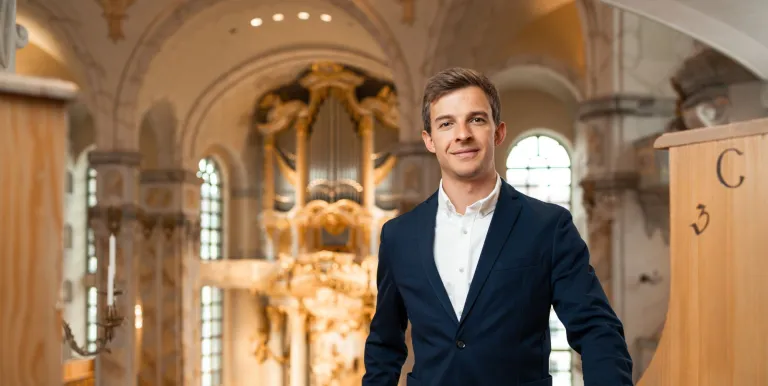
Gabriele Agrimonti, Niklas Jahn – organ
Presenters:
László Fassang, Gergely Fazekas
-
The Müpa Budapest Organ Duel series continues, this time featuring two outstanding representatives of the young generation, Niklas Jahn and Gabriele Agrimonti, who will pit their skills and improvisational abilities against each other. The two organists go way back, so they say the contest will take place in a friendly spirit of mutual inspiration that will ensure both of them emerge as winners.
Both artists are characterised by their musical openness and curiosity, and improvisation has played an important role in their careers since the very beginning. “For me, improvisation is like recalling my childhood. I can play freely, exactly the way I want. I can try anything. The expectations society makes of us are mostly about limitations, moderation, and difficulties, while improvisation is the exact opposite: infinite freedom, when the child inside you awakens again,” says Niklas Jahn. Gabriele Agrimonti, on the other hand, emphasizes that even when improvising, one must pay attention to form, structure, and harmony. “It is important to be able to control what we are doing. In my opinion, freedom doesn’t mean doing whatever you want, but rather creating something original while making music within the system you know,” he adds.
Gabriele Agrimonti improvises “at his workplace,” the Church of San Luigi dei Francesi in Rome:
At the same time, there are key differences between the two artists as they come from different musical backgrounds. “Gabriele’s Italian and French musical roots probably differ significantly from the German educational system in which I grew up,” notes Niklas. “In Germany, we place extremely strong emphasis on church music and choral singing. As a child, I was required to sing in a choir, and as a conductor, I work with both choirs and orchestras even now. I believe that in Paris – where Gabriele studied for a long time – musical education is structured quite differently. The French tradition focuses more on training impressive, virtuosic musicians, while German education considers solid academic foundations particularly important.”
Niklas Jahn’s “bizarre dance” on the organ:
They both consider it an important mission to show audiences that the organ is not an outdated instrument used only for sacred ceremonies, but a dynamic, exciting musical medium that can also speak to younger generations.
-
Featuring:
Gabriele Agrimonti, Niklas Jahn – organ
Presenters:
László Fassang, Gergely Fazekas
-
The Müpa Budapest Organ Duel series continues, this time featuring two outstanding representatives of the young generation, Niklas Jahn and Gabriele Agrimonti, who will pit their skills and improvisational abilities against each other. The two organists go way back, so they say the contest will take place in a friendly spirit of mutual inspiration that will ensure both of them emerge as winners.
Both artists are characterised by their musical openness and curiosity, and improvisation has played an important role in their careers since the very beginning. “For me, improvisation is like recalling my childhood. I can play freely, exactly the way I want. I can try anything. The expectations society makes of us are mostly about limitations, moderation, and difficulties, while improvisation is the exact opposite: infinite freedom, when the child inside you awakens again,” says Niklas Jahn. Gabriele Agrimonti, on the other hand, emphasizes that even when improvising, one must pay attention to form, structure, and harmony. “It is important to be able to control what we are doing. In my opinion, freedom doesn’t mean doing whatever you want, but rather creating something original while making music within the system you know,” he adds.
Gabriele Agrimonti improvises “at his workplace,” the Church of San Luigi dei Francesi in Rome:
At the same time, there are key differences between the two artists as they come from different musical backgrounds. “Gabriele’s Italian and French musical roots probably differ significantly from the German educational system in which I grew up,” notes Niklas. “In Germany, we place extremely strong emphasis on church music and choral singing. As a child, I was required to sing in a choir, and as a conductor, I work with both choirs and orchestras even now. I believe that in Paris – where Gabriele studied for a long time – musical education is structured quite differently. The French tradition focuses more on training impressive, virtuosic musicians, while German education considers solid academic foundations particularly important.”
Niklas Jahn’s “bizarre dance” on the organ:
They both consider it an important mission to show audiences that the organ is not an outdated instrument used only for sacred ceremonies, but a dynamic, exciting musical medium that can also speak to younger generations.