Solti International Conducting Competition 2026
In autumn 2026, Müpa Budapest launched the Solti International Conducting Competition, continuing the tradition of the iconic international competition organised by Hungarian Television in 1974. This competion was one of the most important forums for young conductors for decades; with a view to reviving this tradition, the competition taking place between October 1 and 10 offers an opportunity for conductors aged 18-35 from all over the world to prove themselves in the Hungarian concert halls with the finest acoustics as they lead top domestic symphony orchestras in front of the most renowned representatives of the profession.
The competition is named after Sir Georg Solti, one of the greatest conductors of the 20th century, whose career remains exemplary to this day: beyond expertise in his field, his legacy reminds us of the importance of personality, humility in the service of music, and the ability to build community and forge international dialogue. Throughout his life, he consistently supported young, aspiring musicians, holding master classes and setting young conductors, singers and instrumental soloists on the path to the world’s most prestigious podiums. The mission of the competition is to ensure that future conductors are not only excellent musicians, but also influential leaders of their ensembles and genuine cultural ambassadors.
Following a preliminary selection process, the selected competitors will be evaluated in three rounds before a prestigious international Jury in Hungary’s three top concert halls in terms of acoustics: the Concert Hall of the Kodály Centre in Pécs, the Grand Hall of the Liszt Academy, and the Béla Bartók National Concert Hall at Müpa Budapest. The competitors will work with three internationally renowned symphony orchestras – the competition’s collaborating partners – the Pannon Philharmonic from Pécs, the Hungarian Radio Symphony Orchestra, and the Hungarian National Philharmonic Orchestra.
It will be possible to follow the event via online broadcasts. Thanks to Müpa Budapest’s own platforms, those following the competition will also have access to continuously updated contents that will bring the unfolding events closer to viewers.
Competition announcement
The organisers accepted applications online from 1 December 2025 to 20 March 2026. Nearly 400 submissions were received from 61 countries by this deadline.
Sir Georg Solti
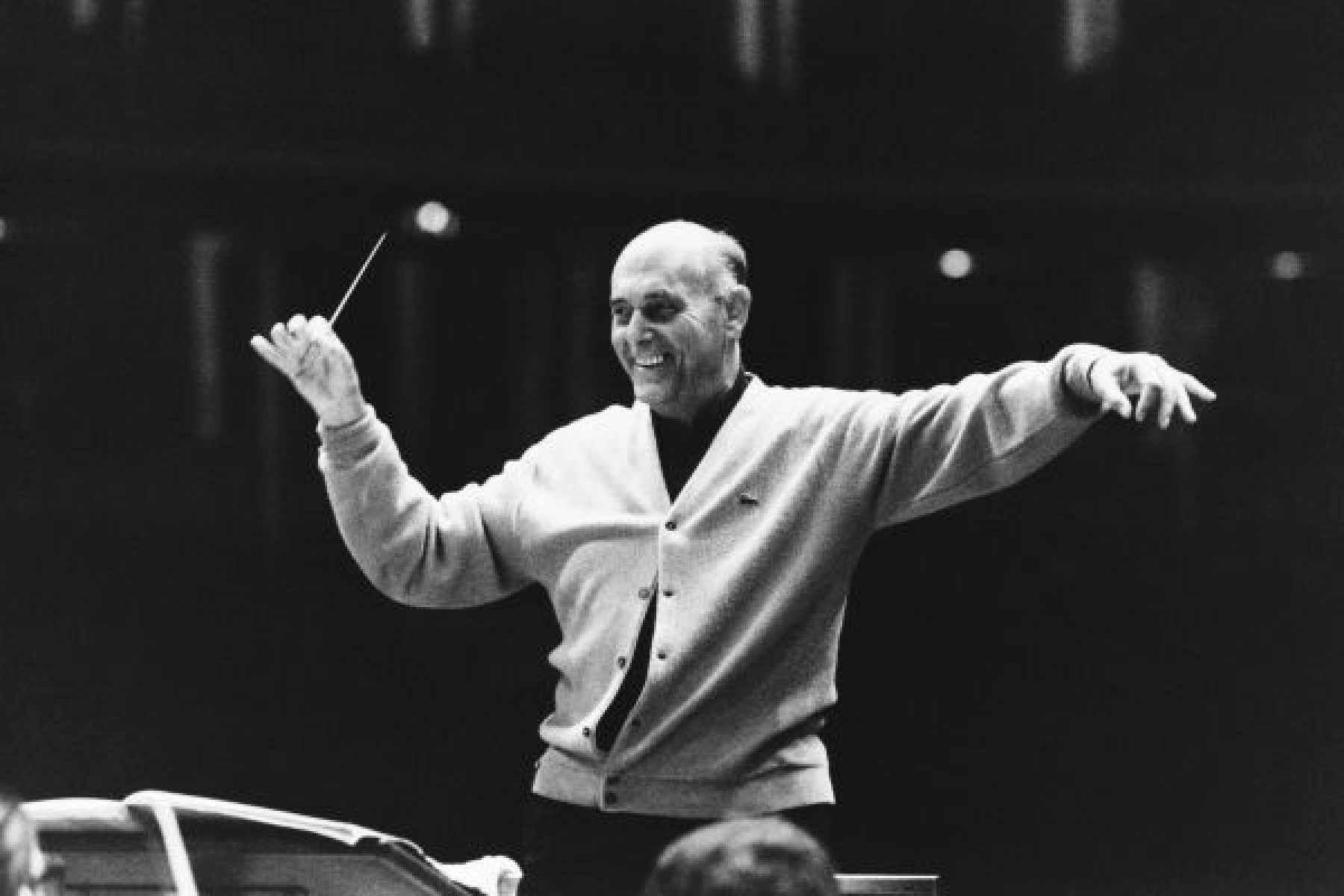
Sir Georg Solti was born on 21 October 1912 in Budapest. He started playing piano aged six and was admitted to the Fodor Music School at ten. He gave a solo recital at the age of just 12 and, not long after, continued his studies at the Liszt Academy of Music, where he was a piano student of Arnold Székely, and later Béla Bartók and Ernő Dohnányi. He initially joined the Hungarian State Opera as a répétiteur, before working as an assistant to the Italian maestro Arturo Toscanini at the Salzburg Festival in 1936 and 1937. He made his debut on the podium in 1938, when he conducted the Mozart opera The Marriage of Figaro in Budapest – on precisely the evening Nazi troops marched into Austria.
With Solti’s professional opportunities in Hungary curtailed on account of his Jewish origin, he fled to Switzerland in 1939. He was unable to obtain a position as a conductor, so he earned his living as a pianist once again, winning the Geneva International Music Competition for piano in 1942. After the war, he conducted Beethoven’s Fidelio in Munich in 1946, a performance that was so well received that he was appointed music director of the Bavarian State Opera. During his tenure, which lasted until 1952, he played a decisive role in the post-war reorganisation of the institution.
Solti recognised the potential of recording early on, which not only served as a basis for his own renown but also bolstered the reputation of his orchestras. From 1947, he made more than 250 albums – including 45 opera recordings – with the Decca label.
In 1952, Solti collaborated with the Hamburg State Opera at the Edinburgh International Festival, and his American debut followed a year later at the San Francisco Opera. For nine years from 1952, he served as general music director of the Frankfurt Opera, before he took the helm of the Royal Opera House in London’s Covent Garden from 1961 to 1971. His goal was to make the institution “simply the world’s best opera house” and, according to critics, he largely succeeded. His powerful, dynamic personality and demanding nature significantly contributed to the elevation of Covent Garden to the global vanguard.
Solti became music director of the Chicago Symphony Orchestra in 1969. This marked the beginning of a legendary collaboration lasting 22 years, during which the orchestra gained worldwide fame.
In the course of his career, Solti received numerous awards. He was knighted by Elizabeth II in 1972, and received the rank of Commander of the French Legion of Honour in 1974, while several universities granted him honorary degrees. In Hungary, he was awarded the Béla Bartók–Ditta Pásztory Prize in 1990, and received the Commander’s Cross with Star of the Order of Merit of the Republic of Hungary in 1993. His haul of 31 Grammy Awards remains unparalleled in both classical and popular music.
Solti worked actively until the last day of his life. Having completed his Memoirs in 1997, he was due to conduct Verdi’s Requiem at the London Proms festival shortly afterwards, but passed away on 5 September, a few days before the concert, in the resort town of Antibes in southern France.
In accordance with his wishes, Solti was laid to rest alongside Béla Bartók’s grave in Budapest. His legacy lives on not only in his recordings but also in the Solti Foundation, established to support young musicians. He is considered one of the greatest conductors of the second half of the last century: his work has served and continues to serve as an inspiration for generations of musicians, and his name still calls to mind a passionate, uncompromising artist.