


Featuring:
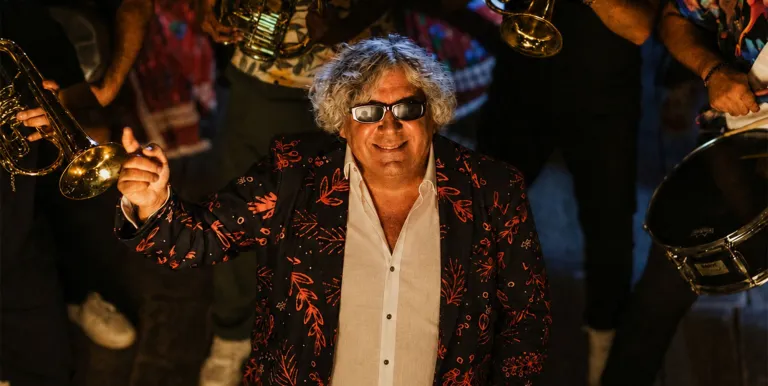
The Senegalese Youssou N’Dour is one of the most influential figures in the music of not just his home country, but the whole of Africa. He has helped popularise African styles such as mbalax and wolof music across the Western world. Indeed, N’Dour has honed the sound of mbalax – a form of Senegalese dance music – to perfection. Through it, he reached people like Peter Gabriel and Paul Simon, and from there found his way into the pop mainstream. Now, N’Dour is returning with a new record, named – appropriately enough – Mbalax.
Of course, Youssou N’Dour, a stunning tenor, has no need to go back to his roots, given that he never left them in the first place. On his mother’s side, N’Dour was born into the family traditions of the griots, West-African storytellers and singers. As a musician, however, he has been continuously developing and shaping those traditions into a modern form through his own sound and the music of his country. As a child, N’Dour sang in Star Band, the most popular Senegalese group of the era, before founding his own group, Étoile de Dakar, which then split into two groups at the start of the 1980s. With Super Étoile de Dakar, N’Dour not only rejuvenated the music of Senegal, but also brought it international recognition. The group went on to exercise a huge influence on Western pop stars, who in turn elevated N’Dour into the international pop music circuit. Which is how he first came to perform in Hungary as part of the Human Rights Now! tour in 1988. Though N’Dour scored a global hit in the 1990s with Neneh Cherry (7 Seconds), it certainly pays to look beyond that success, given that he has become one of the most respected musicians in the world and has produced a string of superb albums. The latest of which is the 2021 Mbalax, which discusses cultural diversity and is an ode to the Africa we know, its present-day stories and the hope of a better future.
Presented by: Müpa Budapest
-
Parking is free of charge for visitors with tickets to any of our paid performances on the day of the performance. Upon entering the car park, you can either scan the barcode or QR code on your concert ticket, or take a parking ticket and validate it together with your concert ticket at one of the payment machines. Either option will enable you to exit through the gates operated by the number plate recognition system. We recommend that you plan to arrive at Müpa in good time, so that you can find the ideal parking spot quickly and without difficulty and arrive at your performance comfortably. The detailed parking policy of Müpa Budapest is available here.