one interval
Featuring:
Soloists:
Hungarian folk culture masters from the Carpathian basin:
Creators:
'The joy of hope came over the people, and swept from their hearts the woes of the year. Mouths produced nothing but song and kind words. No blood was shed in anger that night; instead blood trickled calmly like the brook in Bethlehem, from which waters the sheep, unattended by their shepherds, placidly drank.' (Áron Tamási)
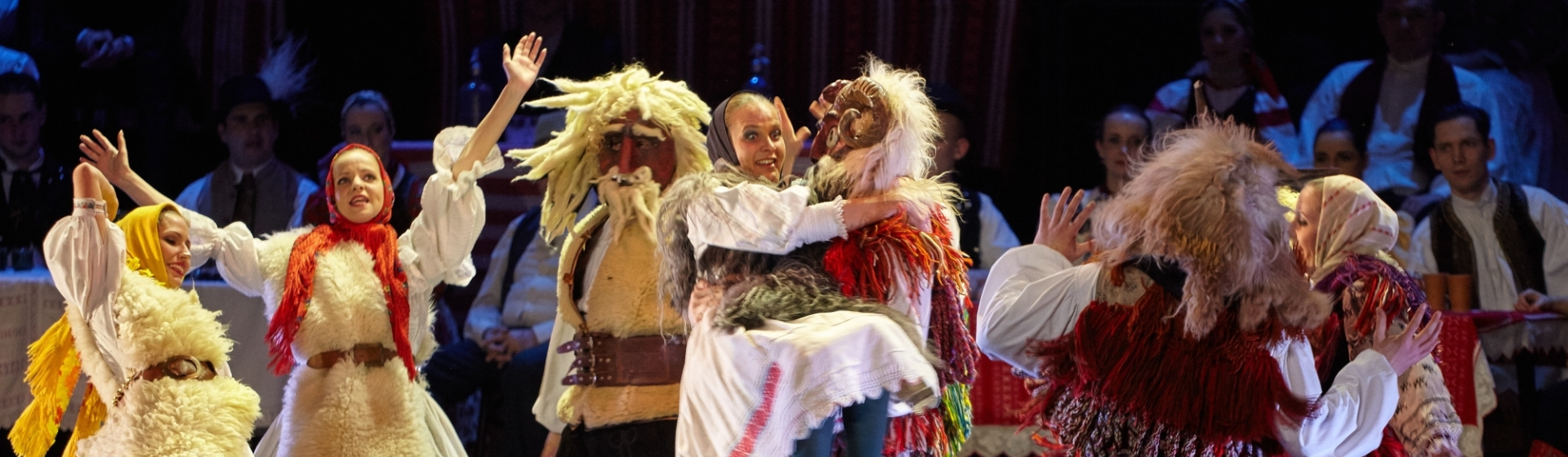
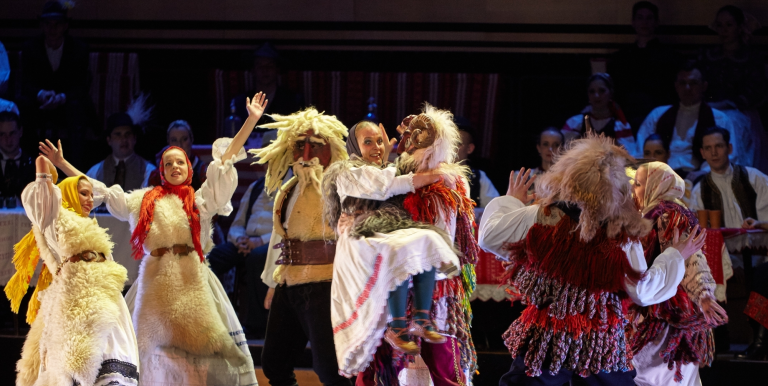
The folk customs and light-hearted magical charms of the New Year's festivities between Christmas and the Epiphany are all aimed at promoting long life and renewed health – for man and beast alike. It is impressive how many ways people can find to ask God for things! Pleadingly, weepingly, chummily and even disingenuously. Traditional village communities have also turned to the Creator with a thousand different artifices to ensure a plentiful harvest and to ward off illness. A large share of these have flourished for centuries – even under prohibition. Often, it was the prohibition and the clandestine behaviour that went with it that unintentionally made them poetic. And perhaps even more than this need for secrecy, the struggle waged with malicious spirits, curses and the devil, in which the fallen angel's battle tactics had to be adopted by giving hidden meaning to words.
In Csíkcsicsó, at one of the most important stages in the Christmas festivities, the veneration of the minor saints, they use a miraculous protective rod they call 'spicy horseradish' on a surface well known to be suitable for spanking, which they call the 'pig's head'. Just as meat can only be made better with horseradish, the same is true with people and a good whacking. Concealment, ingenuity, fun and beauty all merge together here. Our programme presents Hungarian dances, songs and other music in the context of these Christmas pageants. The song and dance on this evening becomes in itself part of the goodwill and magic. Our model is one of the shepherds at the nativity play, who offers the Redeemer – as a gift – a fine dance.
The most emblematic performers in our New Year's programme are the children, the very best contestants from the Fölszálott a Páva television talent show. In their singing and dancing, our ancient cultural heritage shows its capacity for renewal. (András Berecz)
A joint production of the Hungarian Heritage House and MTVA
Presented by: Hungarian Heritage House, MTVA

-
We wish to inform you that in the event that Müpa Budapest's underground garage and outdoor car park are operating at full capacity, it is advisable to plan for increased waiting times when you arrive. In order to avoid this, we recommend that you depart for our events in time, so that you you can find the ideal parking spot quickly and smoothly and arrive for our performance in comfort. The Müpa Budapest underground garage gates will be operated by an automatic number plate recognition system. Parking is free of charge for visitors with tickets to any of our paid performances on that given day. The detailed parking policy of Müpa Budapest is available here.