
one interval
Please note that by buying tickets you are accepting the house rules at Müpa Budapest, which also include the latest regulations and security rules. You can read further details and find key information on this page.
Thank you for your understanding and cooperation.
Conductor:
Featuring:
Stravinsky
Jeu de cartes
Stravinsky
Concerto in D
Stravinsky
Petrushka
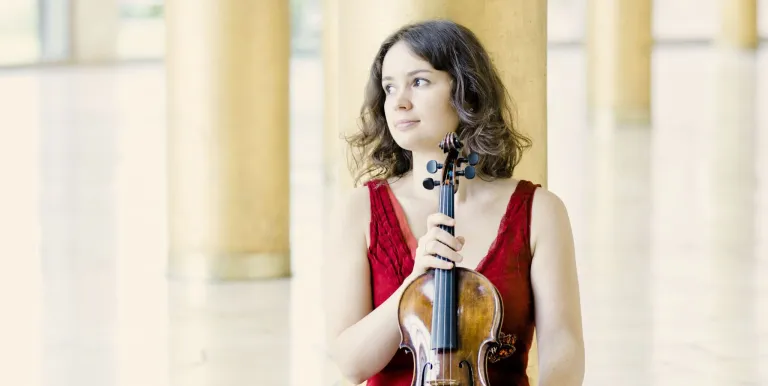
What we'll get to hear at these concerts between a musical narrative of a card game and a ballet treatment of the Pierrot story will be Stravinsky's Violin Concerto, which, interestingly enough, departed so far from the conventions of the genre precisely because of the composer's lack of familiarity with the instrument. As Iván Fischer puts it, soloist Patricia Kopatschinskaja is "extraordinarily creative and sometimes provocative in her originality. She is a violinist of unheard-of imagination."
"In this ballet, the characters are the high cards in the deck in a battle that takes place on a green gaming table. With each hand, the situation is complicated by the endless subterfuge of the cheating Joker, who believes himself unbeatable because of his ability to become any card he likes.” So begins Stravinsky's description of this abstract work comprising a number of brief dance movements. The final twist in Jeu de cartes is also very effective - in the end it turns out that the Joker can be defeated after all, or as Iván Fischer puts it, "It is possible to rebel against card sharps." As for the finale of the Violin Concerto, Stravinsky's biographer Robert Craft termed it one of the most exciting endings the composer ever wrote. Stravinsky, however, was far from certain that his piece would be a success. As his mastery of the instrument's properties was inadequate, he only took on the commission under the condition that Samuel Dushkin, the violinist for whom the piece was intended, would be available for consultation throughout the composition process. All the movements start with the same chord, which Stravinsky first jotted down on a napkin.
The concert will conclude with some of the most important ballet music from Stravinsky's Russian period. In late 1910, the composer was in Switzerland preparing to sketch out the score of the Rite of Spring. However, before starting this strenuous work, as if to relax, he first wrote a concert piece. So taken with this music about the bittersweet clown was Sergei Diaghilev, director of the Ballets Russes, that he encouraged the composer to develop it further. Thus was born Petrushka, the commedia dell'arte figure in the bustle of a Russian fair. The composition is characterized by an ironic and grotesque tone, mockery aimed at emotions and Romanticism, along with ridicule for sentimental audiences. This ballet made up of four scenes is about hopeless love, jealousy and murder.
Presented by: Budapest Festival Orchestra





-
We wish to inform you that in the event that Müpa Budapest's underground garage and outdoor car park are operating at full capacity, it is advisable to plan for increased waiting times when you arrive. In order to avoid this, we recommend that you depart for our events in time, so that you you can find the ideal parking spot quickly and smoothly and arrive for our performance in comfort. The Müpa Budapest underground garage gates will be operated by an automatic number plate recognition system. Parking is free of charge for visitors with tickets to any of our paid performances on that given day. The detailed parking policy of Müpa Budapest is available here.