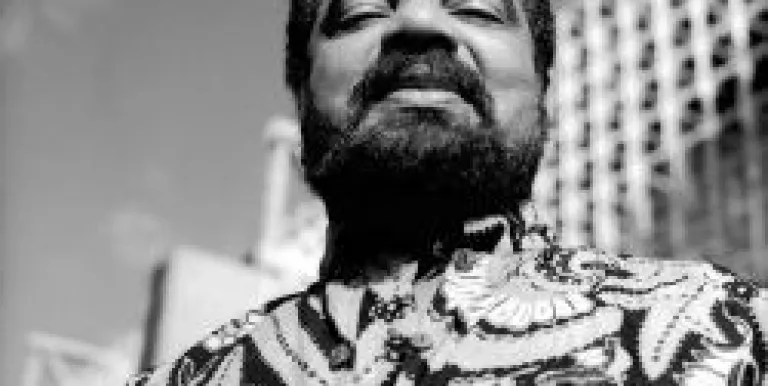
Bonga – vocals, conga, dikanza, Chiemba – bass guitar, Fusica – harmonica, Da Graca – drums, Feijo – guitar Bonga was born in 1942, with the name Barceló de Carvalho, to a working class family in Angola. He had eight siblings but he was the only one who made music: he played the rhythm instrument known as the dikanza, which is made of ribbed bamboo. He led a group, which sang songs protesting against Portuguese imperial rule, but in the sixties, he was barely noticed by either the authorities or other musicians. But he was famous: he was a supreme 400-meter hurdler and represented Portugal internationally. During European competitions, he became closely involved with the émigré Angolan resistance movement. In the seventies, his life was turned upside down and the Salazar dictatorship in Portugal exiled him from the country. He resurfaced in Rotterdam and took the name Bonga, where he made the album Angola 72 which he recorded with musicians from the Cape Verde islands. The music was characterised as much by the melancholy of morna music as Bonga’s revolutionary fervour. It is no surprise at all that ever since, it has been regarded as one of the most influential African records. After Angola obtained its independence, Bonga could choose where to live and so could be found in Paris, Lisbon and Angola. His many records have presented heart wrenching Angolan songs alongside fiery Brazilian sambas, but he was not to equal the same acclaim that greeted Angola 72 – and the subsequent Angola 74 – until 2000 with his album Mulemba Xangola. This granted him entry to the most exclusive club of African performers and two subsequent albums – Kaxexe, Maiorais –, have only gone to cement his reputation.
Presented by:

-
We wish to inform you that in the event that Müpa Budapest's underground garage and outdoor car park are operating at full capacity, it is advisable to plan for increased waiting times when you arrive. In order to avoid this, we recommend that you depart for our events in time, so that you you can find the ideal parking spot quickly and smoothly and arrive for our performance in comfort. The Müpa Budapest underground garage gates will be operated by an automatic number plate recognition system. Parking is free of charge for visitors with tickets to any of our paid performances on that given day. The detailed parking policy of Müpa Budapest is available here.