Please note that by buying tickets you are accepting the house rules at Müpa Budapest, which also include the latest regulations and security rules. You can read further details and find key information on this page.
Thank you for your understanding and cooperation.

Creator:
Featuring:
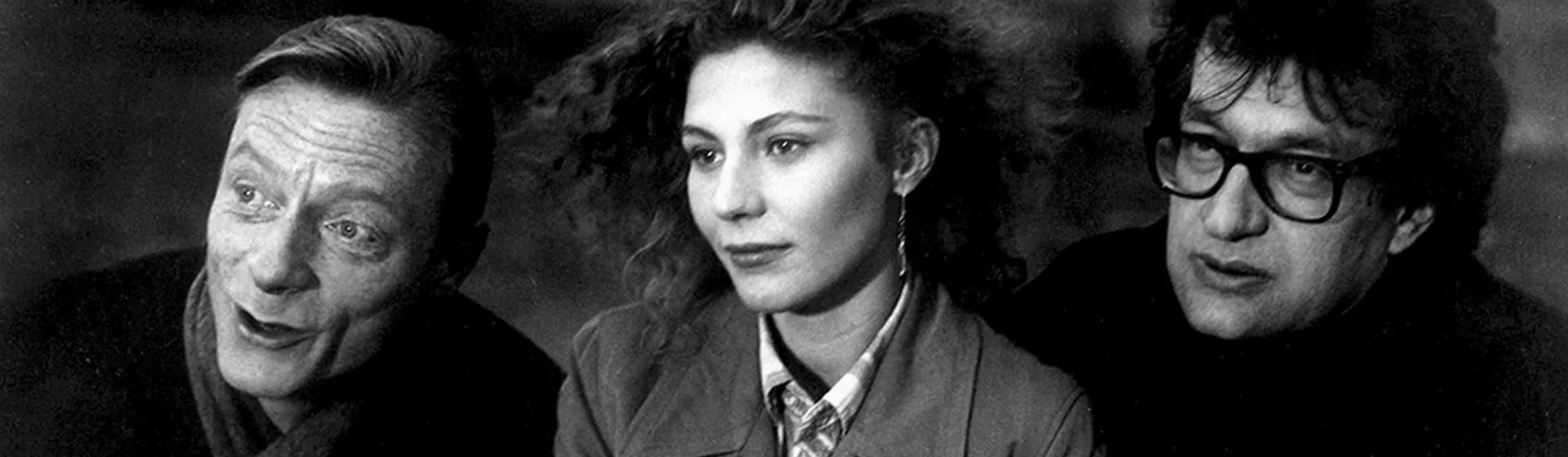
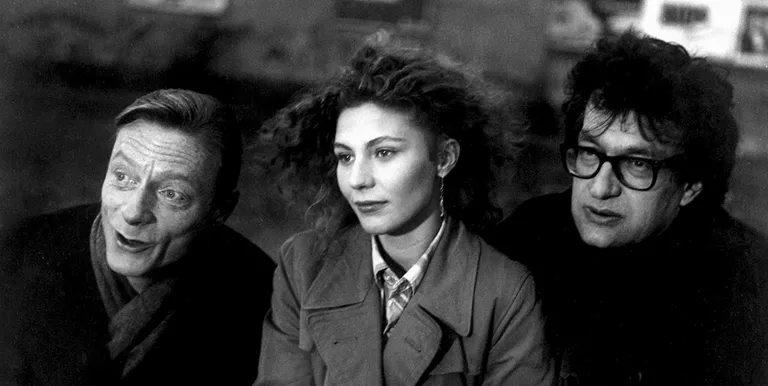
They watch – and do not experience. They cannot be seen by human eyes – children aside – but they can read the thoughts of everyone. Angels. Immortal. This is without doubt the most special and most beautiful film ever made about Berlin. Although the Berlin presented here, cut in two by the Wall, is not beautiful in itself. Yet it is full of life. Wings of Desire is an infinitely poetric creation, though it would be hard to tell such a story any other way – the story of an angel (Damiel – Bruno Ganz) who would like to exchange his immortality for a simple human existence. For aromas, colours, feelings, joy and regret. For life.
Wim Wenders was one of the defining figures of New German Cinema alongside Fassbinder, Werner Herzog and Volker Schlöndorff. The period from the start of the 1970s to the end of the 1990s was incredibly rich and his impact was felt far beyond German cinema. In many ways, Wings of Desire represents both the end of this era and the pinnacle of his artistic career. He made dozens of full-length films in this time. Almost without exception, they make you think about how deeply his European culture is shaped by America, by hard-boiled detective stories, TV series, the world of celebrities, sounds and images. Several of his films draw from this experience: Alice in the Cities, The American Friend, Hammett, and Paris, Texas. What is particularly special is how he makes such a world so intimately European. One of the most important supporting characters in Wings of Desire is another angel who chooses mortal existence: Peter Falk, who plays himself. Though everyone knows him as Lieutenant Columbo. Even better, Wenders also references Walter Ruttmann's 1927 poetic silent documentary too (Berlin: Symphony of a Metropolis ). And an appearance by Nick Cave is also not by chance: in the 1980s, the singer was based in West Berlin.
In German, with Hungarian subtitles.
The discussions before and after the screening will be conducted in Hungarian.
Presented by: Müpa Budapest
-
Parking is free of charge for visitors with tickets to any of our paid performances on the day of the performance. Upon entering the car park, you can either scan the barcode or QR code on your concert ticket, or take a parking ticket and validate it together with your concert ticket at one of the payment machines. Either option will enable you to exit through the gates operated by the number plate recognition system. We recommend that you plan to arrive at Müpa in good time, so that you can find the ideal parking spot quickly and without difficulty and arrive at your performance comfortably. The detailed parking policy of Müpa Budapest is available here.