Digital programme booklet
-
Performers:
Wife: Júlia Juhász-Paput
Husband: Attila Tókos
Barcsai, the lover: Dávid Barka
Village people: dancers of the Hungarian National Dance Ensemble
(professional leader: Zsuzsa Zs. Vincze, artistic director: Zoltán Zsuráfszky)
Soldiers, shepherds, judges: Hungarian National Male Choir
(choirmaster: Richárd Riederauer)Creators:
Music: Benjamin Eredics
Folk music editor: István Gázsa Papp, Sándor D. Tóth
Set: Kázmér Tóth
Lighting: Dániel Kósa, István Niederkirchner
Animation: Szilvia Fabók, Boáz Konta
Libretto, dramaturg, costumes, associate director: Zsuzsa Zs. Vincze
Choreographer, director: Zoltán ZsuráfszkyThe performance includes two choral works by Zoltán Kodály, Evening Song and Soldiers’ Song.
The premiere was an event of the Bartók Spring, jointly presented by Müpa Budapest and Hungarian National Dance Ensemble.

-
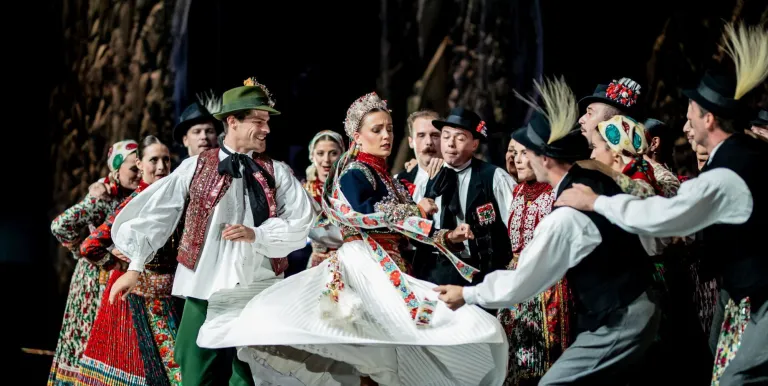
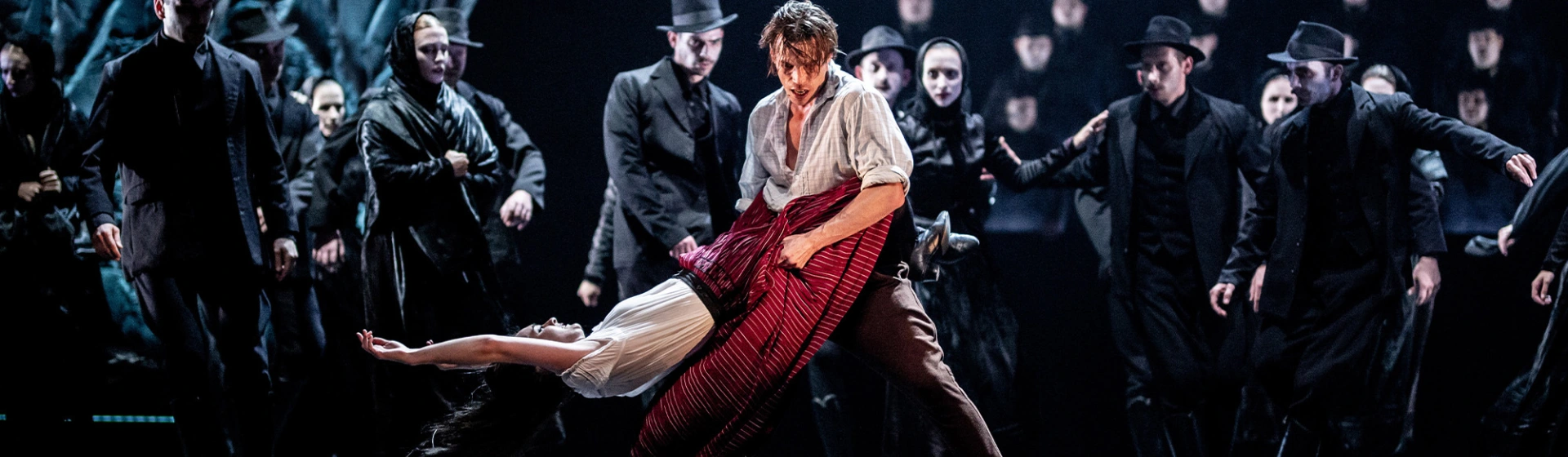
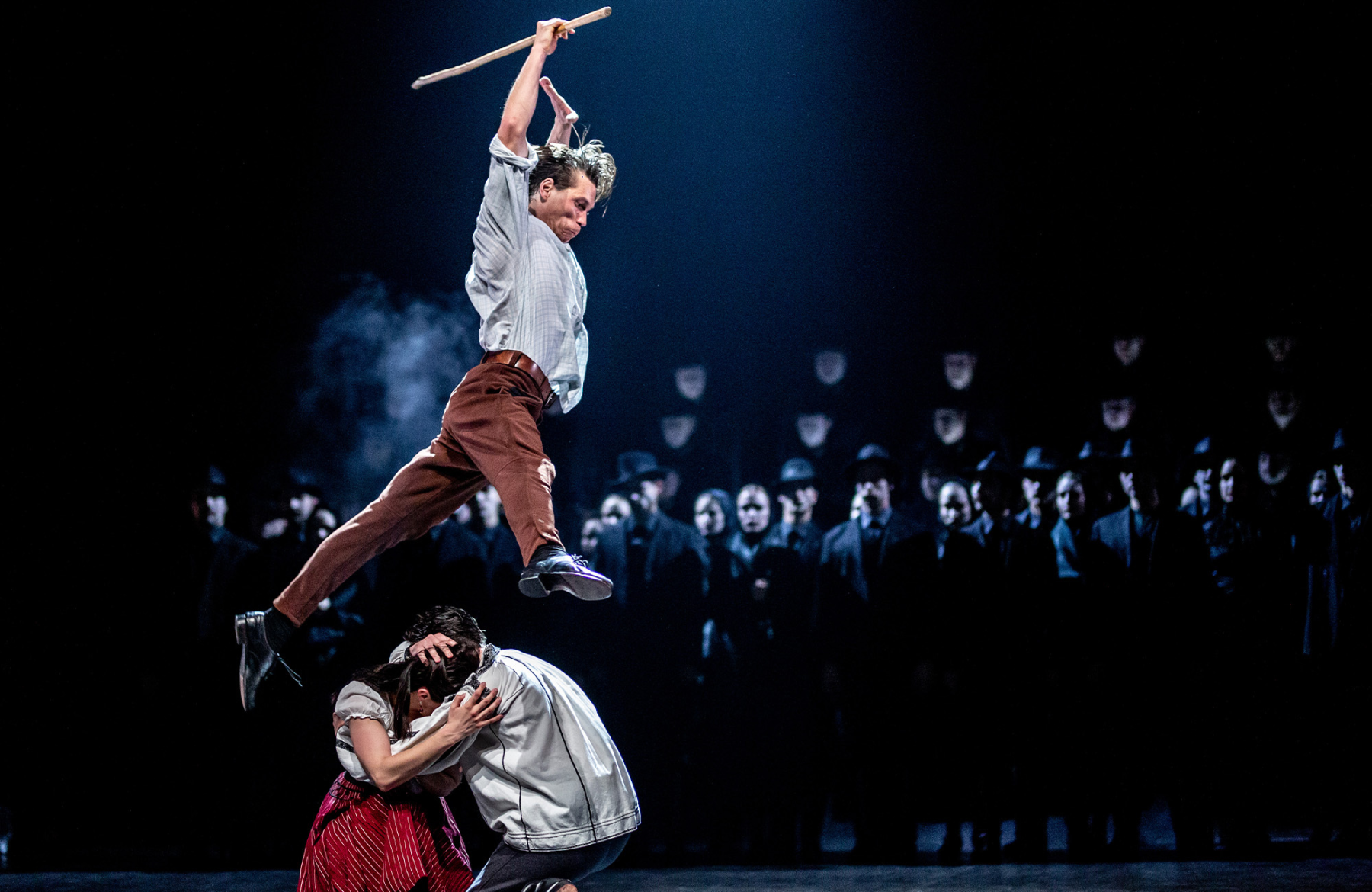
The production recounts the strange story of a woman punished with death for infidelity, one of the most mysterious old Hungarian ballads, a tale of cruel beauty and tragedy that represents some of the most profound human emotions. The original folk ballad says little about the adulterous woman and the reasons for her infidelity, while the husband’s bloody revenge, the burning of the unfaithful wife, is discussed in detail. The dance drama completes the story, “unravels” the cause of the woman’s infidelity, the possible motivations of the “sinners,” and seeks an explanation for the actions of the characters.
© MNTE / Sándor Csudai
The male protagonist, Barcsai, returns home after a long military service, and finds himself in the middle of a wedding feast. The girl he loved did not wait for him, and is about to marry a rich man. Despite the conflicts that emerge at the feast, the wedding is concluded, and Barcsai, who has lost his love, leaves the village. Years go by, and just as the tedium of the marriage of convenience and the suffering is becoming intolerable for her, her old love, Barcsai appears...
The subject is still of interest. Jealousy, infidelity, unfaithfulness, the “burning” passion of irresistible, overwhelming love – these are the perennial subjects of the relationship between a man and a woman. Rendered in dance, the ballad makes use of the world of Hungarian folk dance and music to study the human soul, fusing “primitive” emotions with “primitive” motions and music.
The Hungarian National Dance Ensemble is one of the largest professional folk dance ensembles in Hungary. Its “mother tongue” is the folk dance repository of the Carpathian Basin, which has given rise to a colourful repertoire with large-format historical ballets to authentic folklore performances, and from rock operas to folk tradition-based children’s productions. The ensemble’s name faithfully reflects their mission: promoting the Hungarian folk dance tradition of the Carpathian Basin in Hungary, Europe and overseas.
The Hungarian National Male Choir is the only professional male choir in Hungary, regularly featured in operas and concert halls, both in Hungary and abroad. When it was founded in 1949, the ensemble was already synonymous with a special sound, which over the years came to be coupled with an advanced performing sensibility. In addition to traditional classical and contemporary responsibilities, the choir does not mind taking excursions into the realm of crossover.
Kossuth Prize laureate choreographer Zoltán Zsuráfszky became artistic director of the unified Honvéd Dance Theatre in 2007, and in 2012 that of the whole Honvéd Ensemble. In 2014, Honvéd Dance Theatre was renamed, on his initiative, Hungarian National Dance Ensemble, of which he is still artistic director. He is also managing director of Honvéd Ensemble. As head of the dance collecting team, he took part in the largest folk music collection initiative of recent years, the programme called Last Hour.
-
Performers:
Wife: Júlia Juhász-Paput
Husband: Attila Tókos
Barcsai, the lover: Dávid Barka
Village people: dancers of the Hungarian National Dance Ensemble
(professional leader: Zsuzsa Zs. Vincze, artistic director: Zoltán Zsuráfszky)
Soldiers, shepherds, judges: Hungarian National Male Choir
(choirmaster: Richárd Riederauer)Creators:
Music: Benjamin Eredics
Folk music editor: István Gázsa Papp, Sándor D. Tóth
Set: Kázmér Tóth
Lighting: Dániel Kósa, István Niederkirchner
Animation: Szilvia Fabók, Boáz Konta
Libretto, dramaturg, costumes, associate director: Zsuzsa Zs. Vincze
Choreographer, director: Zoltán ZsuráfszkyThe performance includes two choral works by Zoltán Kodály, Evening Song and Soldiers’ Song.
The premiere was an event of the Bartók Spring, jointly presented by Müpa Budapest and Hungarian National Dance Ensemble.
-
The production recounts the strange story of a woman punished with death for infidelity, one of the most mysterious old Hungarian ballads, a tale of cruel beauty and tragedy that represents some of the most profound human emotions. The original folk ballad says little about the adulterous woman and the reasons for her infidelity, while the husband’s bloody revenge, the burning of the unfaithful wife, is discussed in detail. The dance drama completes the story, “unravels” the cause of the woman’s infidelity, the possible motivations of the “sinners,” and seeks an explanation for the actions of the characters.
© MNTE / Sándor Csudai
The male protagonist, Barcsai, returns home after a long military service, and finds himself in the middle of a wedding feast. The girl he loved did not wait for him, and is about to marry a rich man. Despite the conflicts that emerge at the feast, the wedding is concluded, and Barcsai, who has lost his love, leaves the village. Years go by, and just as the tedium of the marriage of convenience and the suffering is becoming intolerable for her, her old love, Barcsai appears...
The subject is still of interest. Jealousy, infidelity, unfaithfulness, the “burning” passion of irresistible, overwhelming love – these are the perennial subjects of the relationship between a man and a woman. Rendered in dance, the ballad makes use of the world of Hungarian folk dance and music to study the human soul, fusing “primitive” emotions with “primitive” motions and music.
The Hungarian National Dance Ensemble is one of the largest professional folk dance ensembles in Hungary. Its “mother tongue” is the folk dance repository of the Carpathian Basin, which has given rise to a colourful repertoire with large-format historical ballets to authentic folklore performances, and from rock operas to folk tradition-based children’s productions. The ensemble’s name faithfully reflects their mission: promoting the Hungarian folk dance tradition of the Carpathian Basin in Hungary, Europe and overseas.
The Hungarian National Male Choir is the only professional male choir in Hungary, regularly featured in operas and concert halls, both in Hungary and abroad. When it was founded in 1949, the ensemble was already synonymous with a special sound, which over the years came to be coupled with an advanced performing sensibility. In addition to traditional classical and contemporary responsibilities, the choir does not mind taking excursions into the realm of crossover.
Kossuth Prize laureate choreographer Zoltán Zsuráfszky became artistic director of the unified Honvéd Dance Theatre in 2007, and in 2012 that of the whole Honvéd Ensemble. In 2014, Honvéd Dance Theatre was renamed, on his initiative, Hungarian National Dance Ensemble, of which he is still artistic director. He is also managing director of Honvéd Ensemble. As head of the dance collecting team, he took part in the largest folk music collection initiative of recent years, the programme called Last Hour.