Digital programme booklet
-
Performed by:
Duna Art Ensemble and the Göncöl Band
Featuring:
Borbála Fekete – voice
Featuring from recordings:
Izabella Caussanel – voice
Álmos Gáspár – violin
Sándor Csoóri Jr – viola, kontra, tamburica, Irish bouzouki
Péter Friderikusz – cello
Dávid Lakatos – double bass
Gábor Földes – bass guitar
Béla Szerényi Jr – tárogató, recorder
Patrik Sebestyén – trumpet, flugelhorn
Zsombor Herédi – harmonica
Botond Őri Kiss – piano
Márk Csernovszki – harp
Áron Horváth – cimbalom
Masato Okazaki – musical sawCreators:
Music: Sándor Csoóri Jr
Music editor: István “Szalonna” Pál
Dramaturg: Orza Călin
Set: Gábor Michac
Projection: Mihály Lukács
Costumes: Borbála Winkler Petri-Kiss, Rita Furik
Dance masters: Berta Módos Almási, Máté Módos, Balázs Sáfrán, Csaba Szabó, Ágnes Farkas, Beáta Gaschler, Áron Antal, Anett Nagypál
Dance ensemble directors: Gyula András Soós, Katalin Bonifert
Choreographers: Tamás Farkas, Norbert “Cimbi” Kovács, Ignác Kádár, Zsolt Juhász, Orza Călin
Director: Zsolt JuhászThe premiere was presented by Müpa Budapest as a joint event with the Duna Art Ensemble as part of the Bartók Spring.

-
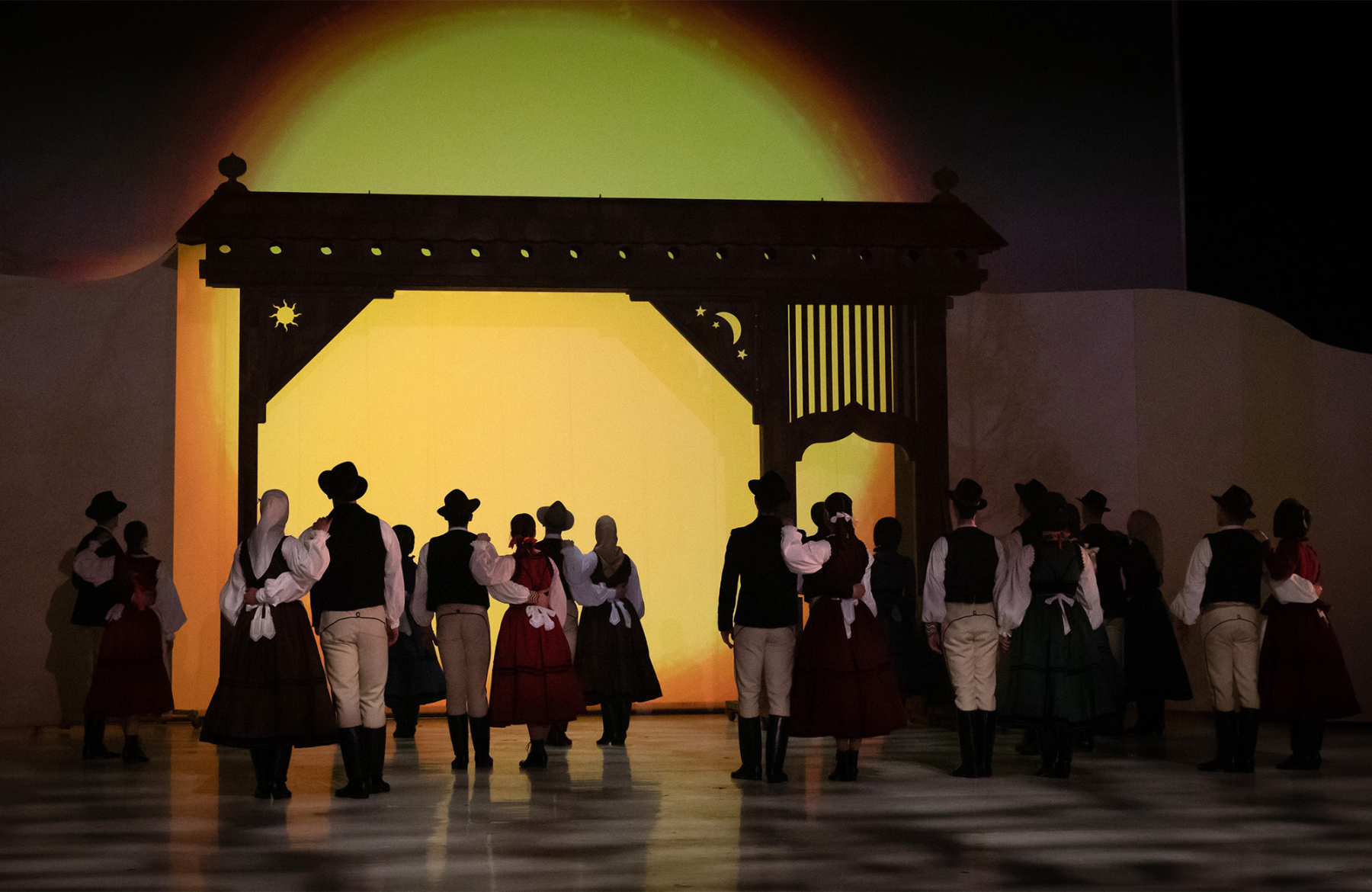
‘The Székely gate is the peak of Hungarian folk art, including monumental woodcarving, as well as folk architecture,’ wrote the ethnographer Iván Balassa M. ‘Traditionally called large, roofed or dovecote gate, they have been called Székely gates since the early 1900s, after the Székely Land, which by that time had become the last refuge of the custom. It has three posts, connected at the top by a horizontal beam, on which a dovecote is often built. The distance between the posts is different, allowing space for a large and a small gate, i.e. for freight and foot traffic.’ This special structure is a symbol of ancient power. It is an object of sacred significance, a symbol of faith, hope, belonging to God, a channel of communication between heaven and earth. Its three posts represent the unity of body, soul and spirit, and its carvings are symbols that render protection, grace and blessing, while being impressions of the energy of the universe.
© Kállai-Tóth Anett
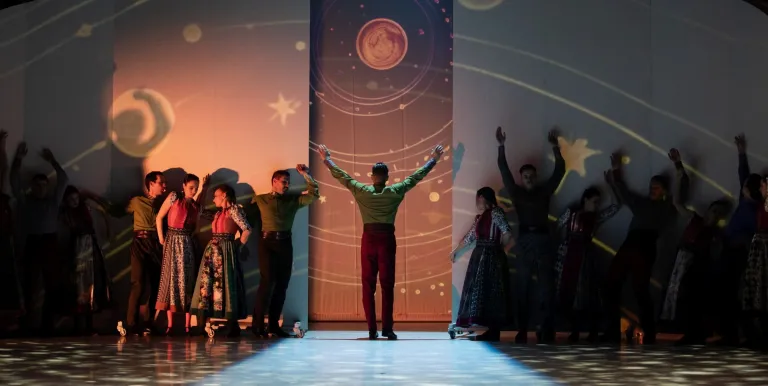
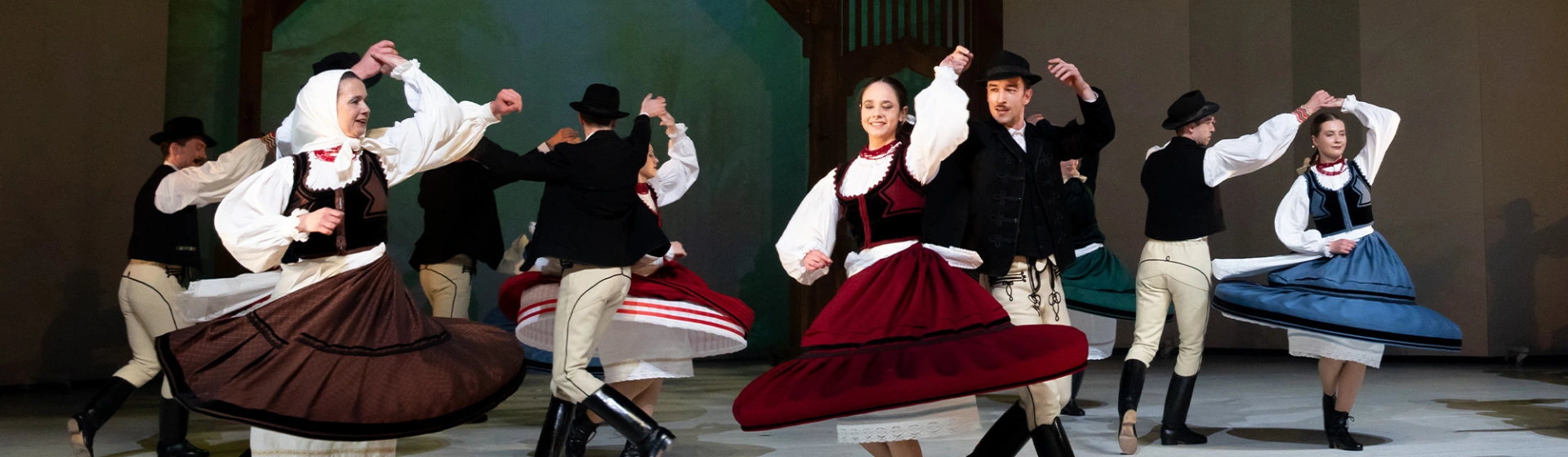
The Duna Art Ensemble drew inspiration for its two-part production from this richly meaningful construction. The first part is a chronicle in dance of the origins of the Székely people. Different songs bring to life the mythical past, the world of ancient origin stories – the tales of the Sky and the Earth, the marriage of the Sun and the Moon, Nimród and his sons, Hunor and Magor, the chase of the Magic Stag, the birth of the Székely people – as well as the most significant places, events and personalities in the history of the Székelys, evoking the peasant uprising of György Dózsa, Sándor Kőrösi Csoma’s journey to Asia, the Siculicidium, or, the Mádéfalva Massacre, the Babba Mária of Csíksomlyó, the Virgin Mary in the Sun. The colours and shapes of the dancers’ costumes reinforce the mythical content, the designer uses the striped pattern, typical of the Székely costume, as a symbol of life. The world music melodies are drawn from the collections of Béla Bartók, and folk songs of both the old and the new style can be heard.
The second part of the performance wanders through the Székely Land, with the artists guiding the audience through this ancient and incredibly colourful territory with the help of music and dances from the different regions. This act features authentic Székely folk costumes and folk music.
-
Performed by:
Duna Art Ensemble and the Göncöl Band
Featuring:
Borbála Fekete – voice
Featuring from recordings:
Izabella Caussanel – voice
Álmos Gáspár – violin
Sándor Csoóri Jr – viola, kontra, tamburica, Irish bouzouki
Péter Friderikusz – cello
Dávid Lakatos – double bass
Gábor Földes – bass guitar
Béla Szerényi Jr – tárogató, recorder
Patrik Sebestyén – trumpet, flugelhorn
Zsombor Herédi – harmonica
Botond Őri Kiss – piano
Márk Csernovszki – harp
Áron Horváth – cimbalom
Masato Okazaki – musical sawCreators:
Music: Sándor Csoóri Jr
Music editor: István “Szalonna” Pál
Dramaturg: Orza Călin
Set: Gábor Michac
Projection: Mihály Lukács
Costumes: Borbála Winkler Petri-Kiss, Rita Furik
Dance masters: Berta Módos Almási, Máté Módos, Balázs Sáfrán, Csaba Szabó, Ágnes Farkas, Beáta Gaschler, Áron Antal, Anett Nagypál
Dance ensemble directors: Gyula András Soós, Katalin Bonifert
Choreographers: Tamás Farkas, Norbert “Cimbi” Kovács, Ignác Kádár, Zsolt Juhász, Orza Călin
Director: Zsolt JuhászThe premiere was presented by Müpa Budapest as a joint event with the Duna Art Ensemble as part of the Bartók Spring.
-
‘The Székely gate is the peak of Hungarian folk art, including monumental woodcarving, as well as folk architecture,’ wrote the ethnographer Iván Balassa M. ‘Traditionally called large, roofed or dovecote gate, they have been called Székely gates since the early 1900s, after the Székely Land, which by that time had become the last refuge of the custom. It has three posts, connected at the top by a horizontal beam, on which a dovecote is often built. The distance between the posts is different, allowing space for a large and a small gate, i.e. for freight and foot traffic.’ This special structure is a symbol of ancient power. It is an object of sacred significance, a symbol of faith, hope, belonging to God, a channel of communication between heaven and earth. Its three posts represent the unity of body, soul and spirit, and its carvings are symbols that render protection, grace and blessing, while being impressions of the energy of the universe.
© Kállai-Tóth Anett
The Duna Art Ensemble drew inspiration for its two-part production from this richly meaningful construction. The first part is a chronicle in dance of the origins of the Székely people. Different songs bring to life the mythical past, the world of ancient origin stories – the tales of the Sky and the Earth, the marriage of the Sun and the Moon, Nimród and his sons, Hunor and Magor, the chase of the Magic Stag, the birth of the Székely people – as well as the most significant places, events and personalities in the history of the Székelys, evoking the peasant uprising of György Dózsa, Sándor Kőrösi Csoma’s journey to Asia, the Siculicidium, or, the Mádéfalva Massacre, the Babba Mária of Csíksomlyó, the Virgin Mary in the Sun. The colours and shapes of the dancers’ costumes reinforce the mythical content, the designer uses the striped pattern, typical of the Székely costume, as a symbol of life. The world music melodies are drawn from the collections of Béla Bartók, and folk songs of both the old and the new style can be heard.
The second part of the performance wanders through the Székely Land, with the artists guiding the audience through this ancient and incredibly colourful territory with the help of music and dances from the different regions. This act features authentic Székely folk costumes and folk music.