

one interval
Conductor:
Featuring:
Creator:
R. Strauss
Also sprach Zarathustra
Rimsky-Korsakov
Scheherazade - ballet première
When Richard Strausspremièred Also sprach Zarathustra in 1896, many people were at a loss as to how one might put a philosophical work to music. The composer's response: 'It was not my intention to write philosophical music or even paint a musical portrait of Nietzsche's great work. Instead, I was aiming to transplant into music the idea of humanity's development from the beginnings, through religion and science, and all the way to Nietzsche's concept of the Übermensch.'At the beginning of the work, Strauss quotes the writer's words: 'When Zarathustra was 30 years old, he left his native land […] and went into the mountains. There he enjoyed his spirit and his solitude, and for ten years did not grow weary of it. But at last his heart changed - and rising one morning with the rosy dawn, he went out into the sunlight and spoke thus unto it: […] Zarathustra wishes to be a man again”. The monumental musical depiction of the sunrise became widely familiar thanks to Stanley Kubrick, who used the first 21 measures of the piece in his film 2001: A Space Odyssey.
The second part of the evening features Rimsky-Korsakov's 1888 musical suite Scheherazade, which presents the world of the Arabian Nights through brilliant instrumentation seasoned with Oriental flavours. The author used four stories in his piece: the first is the tale of Sinbad the Sailor; the second evokes the tricks of the Kalandar Prince, the third relates the love between a young prince and princess and the fourth takes us from the whirlwind of a Baghdad celebration to the scene of a ship being splintered after colliding into a magnetic mountain on a stormy sea. The score calls for a large Romantic orchestra, with a key role played by the solo violin, which personifies Scheherazade herself. The performance is also a contemporary dance première bringing the story to life through the choreography of Yvette Bozsik.
The performance is recommended for those aged 14 and over.
Presented by: Dohnányi Orchestra Budafok, Müpa Budapest
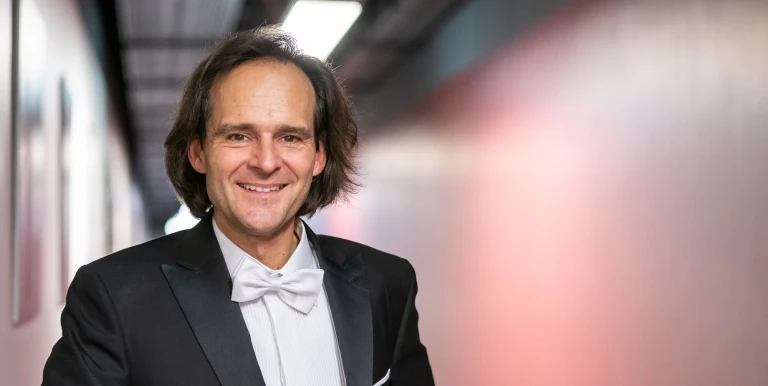




-
We wish to inform you that in the event that Müpa Budapest's underground garage and outdoor car park are operating at full capacity, it is advisable to plan for increased waiting times when you arrive. In order to avoid this, we recommend that you depart for our events in time, so that you you can find the ideal parking spot quickly and smoothly and arrive for our performance in comfort. The Müpa Budapest underground garage gates will be operated by an automatic number plate recognition system. Parking is free of charge for visitors with tickets to any of our paid performances on that given day. The detailed parking policy of Müpa Budapest is available here.