
Claude Gervaise
French Renaissance Dances (Branle de Champaigne, Branle de Bourgogne, Allemande)
Eustache Du Caurroy
Five Fantasies on “Une Jeune Fillette”
Louis Claude Daquin
Variations on a French Christmas Carol
J. S. Bach
“Wachet auf, ruft uns die Stimme”– chorale, BWV 645
Bach
Prelude and Fugue in D major, BWV 532
Handel
Organ Concerto in B flat major
Mendelssohn
Variations Sérieuses (op. 54 for piano, transcribed by R. Smits)
Charles Marie Widor
Symphony No. 9 in C minor (“Gothic”), op. 70 – Andante
Jean Bouvard
Variations on a Basque Christmas Song
Poulenc
Concerto in G minor for organ, strings and timpani
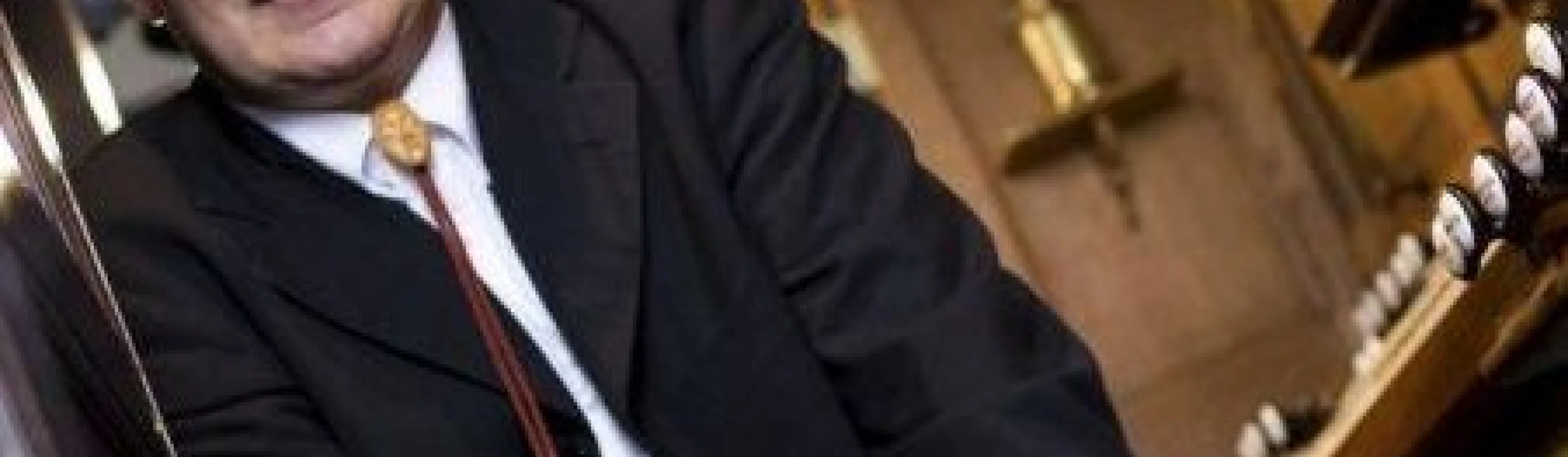
Michael Bouvard, the distinguished French organist was born to a musical family and it was the influence of his grandfather, the organ composer Jean Bouvard which inspired him with his love of the instrument. He studied at the Paris Conservatoire and in 1983 won the Toulouse competition, two years later was appointed regional professor and then in 1995 became professor at the Paris Conservatoire. He and Olivier Latry shared the duties of teaching organ and interpretation. In 1996 he became the organist of the Saint Sernin cathedral in Toulouse which houses a famous Cavaillé-Coll organ. His Christmas programme features two grandiose compositions. Widor’s 9th and final organ symphony looks to symphonic form for inspiration and is based on Gregorian themes. Widor was able to innovate in the realm of organ symphonies in the last third of the 19th century because of the technical improvements of the Cavaillé-Colla organ which produced new orchestral sonorities. Poulenc composed his organ concerto in 1938. It is cast in a single movement with four distinct sections. Accompanied by string chamber orchestra and timpani, it is a massive work with much elemental music and filled with rich invention. And yet it also evokes works from an earlier era. Its fascinating opening is clearly modelled on Bach’s Fantasy and Fugue in G minor BWV 542, but in its entirety brings to life the world of French Gothic cathedrals: their grandure and also their small details. It was premièred in 1941 by Maurice Duruflé and conductor Charles Münch. Its Hungarian première was given by Pierre Cochereau.
Presented by:


-
We wish to inform you that in the event that Müpa Budapest's underground garage and outdoor car park are operating at full capacity, it is advisable to plan for increased waiting times when you arrive. In order to avoid this, we recommend that you depart for our events in time, so that you you can find the ideal parking spot quickly and smoothly and arrive for our performance in comfort. The Müpa Budapest underground garage gates will be operated by an automatic number plate recognition system. Parking is free of charge for visitors with tickets to any of our paid performances on that given day. The detailed parking policy of Müpa Budapest is available here.