Interviews
Interview with Ádám Fischer
“Here, Wagner is easier to hear – and to understand”
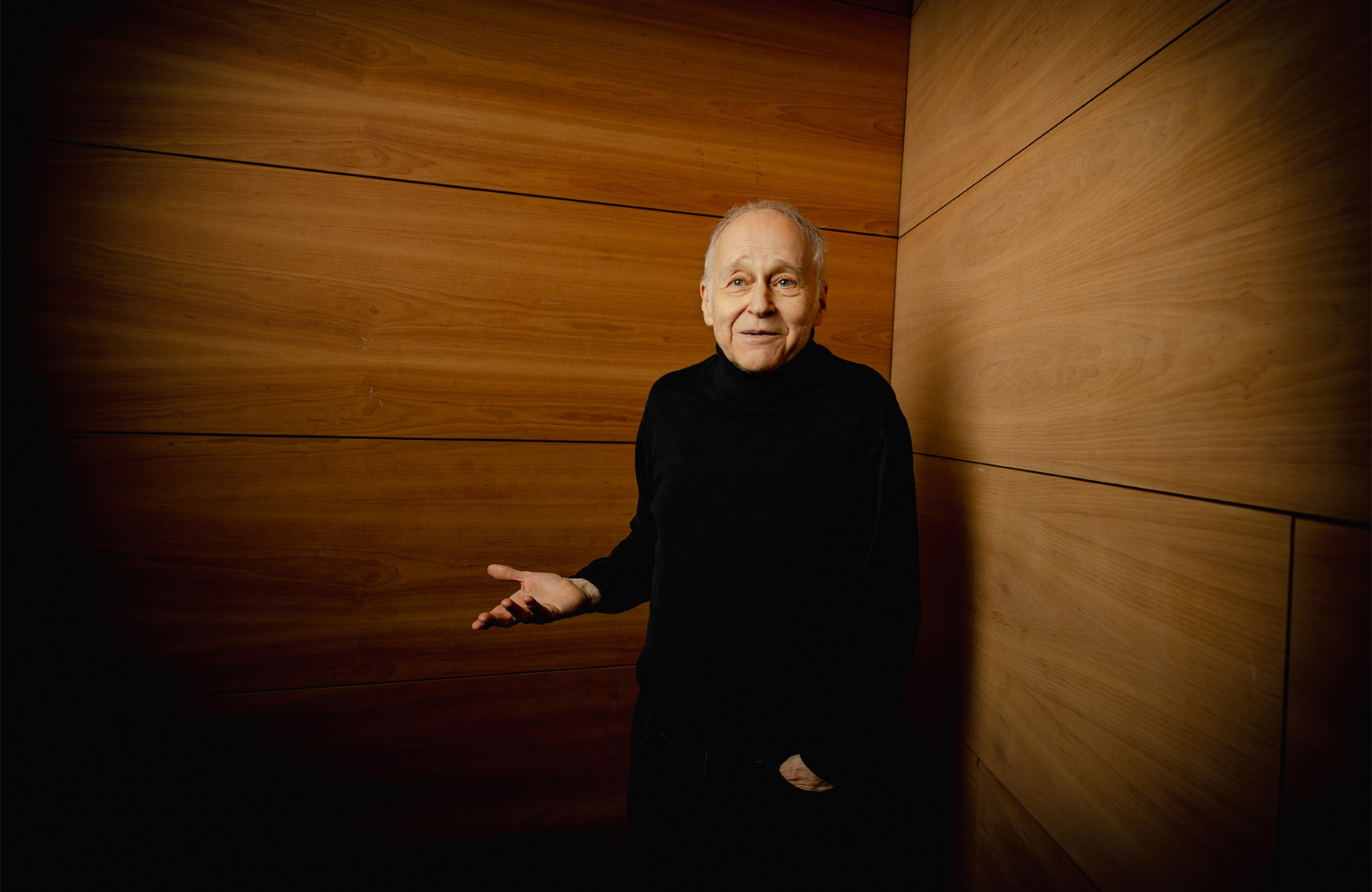
It was exactly 20 years ago that the Budapest Wagner Days series first kicked off. Ever since then, founding artistic director Ádám Fischer has remained an indispensable presence and leading figure in these celebrations of Wagner’s work at Müpa Budapest. This year, however, the conductor will be bidding farewell to The Ring of the Nibelung. And so we asked him to share his recollections of the Budapest Ring – as well as to talk about Parsifal, which this time will be presented to the audience in a distinctly music-focused production.
– How did your personal journey as a conductor lead you to Wagner and the Budapest Ring?
– I would have been about nine or ten years old here in Hungary, which at the time was completely cut off from the West, when Hungarian Radio first broadcast a performance from the Bayreuth Festival. This was a huge event for our family. I think it was Tannhäuser that was playing, and we had to listen to it in a disciplined manner, sitting in chairs and remaining completely silent. I would be lying if I said I had suddenly discovered Wagner for myself. Those three hours are among the most awful memories of my childhood! It’s a wonder I didn’t come to hate Wagner altogether. But when I was around 15, I came across Tristan, and it is only a slight exaggeration to say that, for the next few years, almost nothing else existed for me. To such an extent that I even started to regard Wagner’s other operas with a certain disdain for their failure to attain the same lofty heights. Of course, this opinion later changed and grew much more nuanced, but it took quite a while before conducting Wagner became a truly important, and prominent, part of my career.
– In some interviews, you have referred to yourself as an ‘accidental’ Wagner conductor.
– When I ended up in Mannheim around the turn of the millennium, they persuaded me to conduct Wagner, saying that the audience expects a chief music director to conduct the Ring. I tried to avoid the undertaking, but in the end I took it on, as it happened, shortly before Bayreuth suddenly found itself in need of a Ring conductor following the death of Giuseppe Sinopoli. This is how it began, this story that would later have such a significant impact on my career. In Bayreuth – where I conducted the Ring and Parsifal for a few years – I came to understand a side of Wagner’s music that had not been completely clear to me before. Of course, although musicians and conductors are not paid to ‘enjoy’ the music, conducting in Bayreuth is particularly challenging technically, as you can barely hear the singers in the orchestra pit. The orchestra is loud, especially the winds, and yet the end result in the auditorium is quite impressive. It was there that I realised the true meaning of many bars – that, yes, that is why Wagner wrote them exactly the way he did. I learned how Wagner’s music functions, how it breathes. This experience was similar to that of hearing a Baroque piece played on period instruments: it suddenly becomes obvious why Bach chose a given note and not another. Once one understands this, it fundamentally determines their future approaches to the work. This is what happened to me too: a few years after Bayreuth, we did the Ring cycle at the Wiener Staatsoper, and I was able to conduct it in a completely different way. By then, I felt the true function of music, and it changed my attitude towards everything.
Where Music Becomes Visible
– Then came the Budapest Wagner Days and the Budapest Ring.
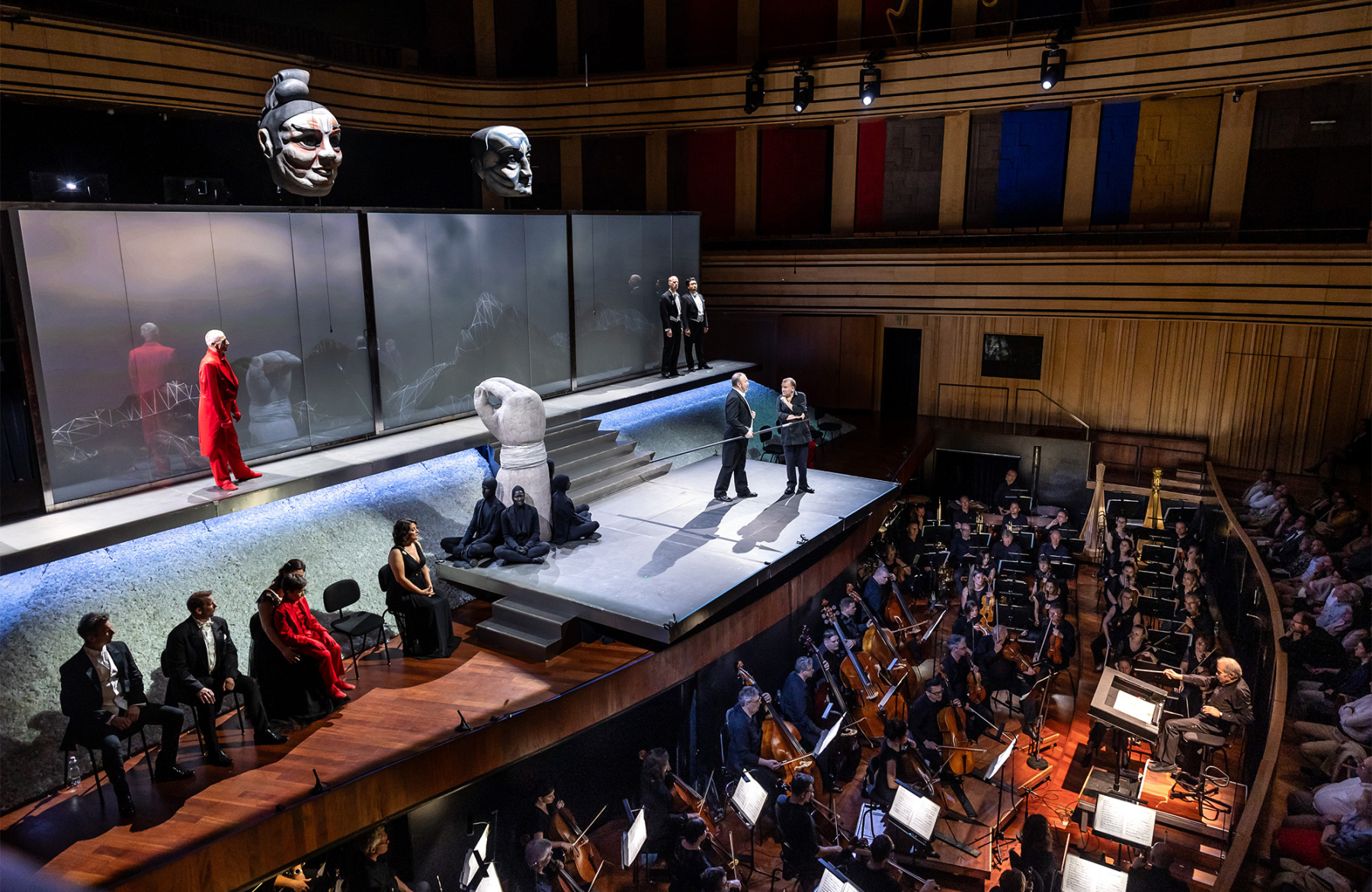
– From the very beginning, the wonderful possibilities afforded by the venue determined the core concept that remains in effect today. This hall allows for a different kind of Wagner performance, a different way of making music. It’s like putting on a fascinating and beautiful garment and finding that one moves in it somehow differently than before. Here, the orchestra (and the conductor) have a much easier time doing their jobs because the musicians can hear each other, they can react to each other, and this opens up room for spontaneity. Furthermore, the audience is better able to hear and understand Wagner’s music, not only thanks to the marvellous acoustics, but also because they can see the musicians. For example, in this hall we can show the six harps used in Das Rheingold, since they are all up on the stage. People are surprised by this and, as a result of the visual effect, they hear and listen to that part differently. But the role of the organ in the second act of Lohengrin also becomes noticeable, something that nine out of ten viewers probably don’t notice when they encounter the piece in an opera house. Back when I was a répétiteur, I used to play the organ part backstage. When it starts at the end of the second act, it’s a big moment in the piece, and since they are also able to watch it at Müpa Budapest, the audience hears more of the music. On the other hand, the fact that Wagner’s works are presented here to the audience in what is decidedly not a traditional opera house setting frees us from a set of uncomfortable expectations. In an opera house, if nothing happens on stage for even five minutes, the audience starts to feel restless. And there’s no denying that opera house stage directors, for far from unrelated reasons, tend to crave excitement and action. In many cases, this complicates the task of finding the appropriate format for presenting a work that truly draws the audience closer into it. At Müpa, however, the Budapest Wagner Days quickly and clearly demonstrated with Parsifal – including to myself, by the way – that even a very small amount of action on stage can be more than sufficient. This is because there is little need for action when someone performs Gurnemanz’s monologue with the intensity and expressiveness that Matti Salminen did! For me, this focus on the music has always been the most important merit and characteristic of the Budapest Wagner Days, and in line with this, we have been constantly experimenting and searching for solutions and forms that are suitable for the given work. I think this also worked well for the Ring. I remember how, after the first performances of the Ring, several people from the audience came up to me to tell me that they had never liked Wagner or the tetralogy before, but how they suddenly liked it now.
– Am I right in thinking that a great many changes took place along the way?
– Certainly, both within myself and, in connection with all this, around the production. Because, for example, in the beginning I felt that a powerful stage spectacle was still needed – even here. So it is with the extras, who can be rehearsed well in advance and thoroughly. With the giant puppets... Or the way it turned out not to be a good idea to send performers up to the third level because they couldn’t make it there on time or would arrive out of breath, so we had to choose a different solution instead. But I was always primarily interested in the musical issues. For example, from which points backstage the Valkyries could sing and where they couldn’t. All of these things could only be discovered by trying them out in real life.
A Bold New Parsifal
– The production of Parsifal we were discussing is one of the most emblematic in the Budapest Wagner Days series. What is the reason for presenting the audience with a new Parsifal?
– There was an entirely practical reason for creating a new Parsifal, as well as a completely artistic, conceptual and, at the same time, personal explanation. To start with the practical factor: we would not have been able to renew this Parsifal staging by Magdolna Parditka and Alexandra Szemerédy, a defining production dating from the launch of the Budapest Wagner Days series, because both of them will be busy in Bayreuth this summer, where they will be directing Rienzi. And our profession is one where we have to try to make the best of every situation, and make a virtue of necessity.
– “It is in self-limitation that a master first reveals himself,” as Goethe wrote.
– If we’re lucky. So since there wouldn’t really be time to create a fully staged Parsifal production during the preparations for the two Ring cycles, we found that we perhaps now had an opportunity to come even closer to the goal or ideal that we discussed earlier and which has motivated me from the beginning when we founded the Budapest Wagner Days: to place the music at the very centre of the opera performances.
– Does the new Parsifal promise development in this regard?
– We are currently moving forward boldly in this direction, Birgit Kajtna-Wönig and I, and Parsifal looks like an ideal choice for this experiment. After all, this final piece in his oeuvre is famously not an opera, but a Bühnenweihfestspiel – a ‘festival play for the consecration of the stage’ – with an unusually introspective plot. The orchestra – as the embodiment of the thoughts and emotions – will also be present on stage. This means the audience will be coming to attend the performance with many different expectations: for the venue, for the acoustic environment, which is now being employed even more spectacularly than before, and for the work itself. I am excited to see how it turns out, because the results will greatly influence my future approach to Wagner’s works and opera in general.
Two Generations, One Shared Mission
– Starting this year, Martin Rajna has joined the Wagner Days team as co-artistic director, and in future the two of you will jointly decide on issues related to the festival’s programmes. Partly in light of this, I’d like to ask what you think about interactions between younger and older generations of musicians, and the differences and points of connection?
– When I was a very young man of 21, I was attending the conducting course at the Vienna Music Academy, a pivotal life experience. I would visit rehearsals with my classmates (including Karajan’s – although we had to hide because he didn’t like having students sitting there), and of course we always had long conversations afterwards about what we had seen. Everyone firmly declared what they thought was ‘terrible’, what the conductor had done wrong, and how much better we would do it than Bernstein or Karajan. And that is actually fine. Young people need this attitude – the belief that they will do things differently, and do them better. Later, of course, when you start running rehearsals yourself, it quickly becomes clear that things don’t work out so easily. But this initial belief, this ambition, is essential, because without it, you can’t even get started. That is why I don’t think the older generation should feel offended if young people want to do everything differently, or better. It’s perfectly all right to want that. That’s the way young people should be – they should have energy, even a bit of revolutionary spirit. Over the years, everyone comes to understand their own limitations.
– Which of course often takes a long time.
– Karajan had a maxim: in order to be a good conductor, one first needs to accumulate 40 years of conducting experience. This profession is heavily reliant on experience. It’s about getting used to an orchestra, knowing how everyone will react to what you do, and how to get the most out of each musician. For example, one of my most important responsibilities is to make sure that the singers are able to sing well. The conductor plays a crucial role in this: does he leave enough time to take a breath, or does he adjust the tempo so that the singer does not get exhausted or run out of air. He must also look beyond any single phrase or aria: for example, if the conductor does not help him with the Forging Song, the tenor singing Siegfried will not be able to handle the final duet. The conductor’s job has always been to get the most out of a given group of artists. However, the trend today of conductors taking on such a central, almost starring, role did not necessarily originate from the world of opera. In fact, looking back, we see a completely different picture. Just think of the world premiere of Parsifal in Bayreuth: the placards listed everyone’s names, even those of the extras, except for the conductor’s. It simply wasn’t what was important to the audience. Moreover, in Bayreuth, the conductor cannot be seen from the auditorium even today. So the most accurate way of summing all this up might be that a good opera conductor is one with whom the singers sing well.
– Let’s retroactively give Hermann Levi his due: he was the one who conducted the world premiere of Parsifal. Back on the subject of Martin Rajna – did you know each other previously?
– Before he started working as a répétiteur and assistant at the Budapest Wagner Days in 2023, I knew Martin’s work mainly from recordings: for example, I watched a truly magnificent version of Bartók’s Concerto for Orchestra on YouTube that he conducted while still a student at the Liszt Academy. But, in addition to my own favourable impressions, when inviting him to serve as assistant and répétiteur, as well as in sharing the duties of artistic director, the opinions the orchestras and the people in the music community had about him were an important consideration. What he has achieved by the age of 30 is quite extraordinary, and I feel that we finally have someone who will take the Budapest Wagner Days into the future in the manner the series deserves.
– The audience has now also learned that this year will be your last time conducting the Ring. Many are obviously wondering whether this means you are bidding farewell to the Budapest Wagner Days altogether.
– There is no question of departing, as I will continue to participate in the Budapest Wagner Days as artistic director, collaborating with Martin in everything. And, of course, I will also be conducting here. For example, next year, if all goes well, I will be here for Tristan und Isolde, the work that illuminated my adolescence.
Interview conducted by Ferenc László
Interview with Martin Rajna
“A treat to be enjoyed not only by the few”
One of the most promising talents of the younger generation of Hungarian conductors, Martin Rajna graduated from Budapest’s Liszt Academy in 2020 and joined the Budapest Wagner Days team as a répétiteur in 2023. He is now co-artistic director of the event series and also serves as principal conductor of the Hungarian State Opera and will take up the post of music director of the Luxembourg Philharmonic later this year. We asked him about his connection to the Wagner festival, and his plans and ideas for it.
– In previous interviews, you mentioned that you first attended the Budapest Wagner Days and Müpa Budapest’s Ring production way back with a standing-room student ticket. To what extent does your past experience influence your ideas and plans as co-artistic director?
– It’s no exaggeration to say that this experience around 2012 is what sucked me in. It is one I wish others to share in too if they come to a performance during the Budapest Wagner Days series. One needn’t be planning a career as a professional musician or conductor to experience what I, like all of us, have experienced: how Wagner’s music enriches our lives. It broadens our emotional and intellectual horizons and provides us with cathartic experiences that very few other art forms can rival. Everything in it comes together as one: the music, the drama, the visuals, the text – and if it’s all done well, it makes for an incomparably complex experience. My aim is to make Wagner a treat to be enjoyed not only by the few, but also by those who, like me, the conservatory student from Dunaújváros, come from far afield to discover this universe for themselves. That is why I took on this assignment: to assist with and, if possible, continue Ádám’s work, hopefully in a manner worthy of his legacy.
Masters
– What have you learned from Ádám Fischer over the years?
– It is thanks to him that I now truly understand many things, and why they happen the way they do. As well as how important it is to build on what the singers bring with them, and how essential it is to support them. For me, this was one of the greatest insights I gained from him. And, of course, this goes far beyond Wagner: it’s actually one of the fundamental principles of all opera conducting. This is because an opera production is not like a symphonic concert, where everything can be rehearsed so meticulously that, with luck, the performance will unfold exactly as planned. In opera, anything can happen at almost any time – and it usually does. This is why one of the conductor’s primary tasks is to respond to everything intuitively and sensitively, while focusing especially on the singers. To be able to breathe along with them and, at all times, to be able to direct the path of the orchestra and the singers in a single direction, into a common channel.
– And what is it that you have learned from Wagner?
– Among other things, I have learned a lot from him about the relationships and proportions between the overall process of performing a work and the small but significant details within it. With Wagner, the text and its content are – in terms of importance – on an equal footing with the music, and also directly influence the musical structure and tempo of the piece. Expressing the meaning of the text, such as a key phrase or a dramatic climax, requires individual freedom, obliging the conductor to take part not only as a musical director, but also as a dramaturg, in interpreting and revealing these dramatic meanings in an appropriate and proportionate fashion. Furthermore, he must be able to convey all of this on a grand scale without ‘chewing’ the work into pieces.
When engaging with the text, much more specific questions of interpretation arise. I often work with the text separately, and in doing so discover more and more new layers being revealed to me. Although music and text are naturally intertwined in the end, the starting point for interpretation is often a deeper understanding of the words. While it is important to expand one’s philological comprehension of the background, when actually conducting the piece, of course, one is no longer thinking about what Wagner wrote in one of his letters, or how the influence of Nietzsche and Schopenhauer manifests itself, or what philosophical directions – for example, Buddhism in Parsifal – lie behind the works. Conducting is a much more practical activity and, during the performance, one must direct all one’s energy towards making it all come together. All the issues that the conductor thinks through during the preparation phase are ‘put aside’, but continue to operate in the background, in the subconscious. Sometimes one or the other surfaces for a moment and influences how the work is shaped – but not in a conscious, analytical way. There is no time to think about philosophical meanings in the midst of all the practical tasks that need to be handled; it is more part of the preparation phase. Furthermore, these deeper connections are often difficult to grasp directly – after all, it is still with the music that we are working.
I haven’t conducted many of Wagner’s works yet, but it is growing increasingly clear to me (and this is still something I need to learn): you can’t conduct continuously for four or five hours at maximum intensity, because you’ll run out of steam by the end. You have to consciously assess which parts are best left to the orchestra to handle on their own, and just let them happen, and identify the climaxes – where the conductor needs to intervene – into which you can really throw yourself.
Brand and appeal
– Coming on board with a fresh perspective, how would you summarise the unmistakably unique Budapest Wagner Days brand?
– First and foremost, it derives from this marvellous acoustic space in which we perform Wagner’s oeuvre. Next is the primacy of the musical implementation, along with the wonderful international cast, which returns to Budapest time and again largely thanks to the level of prestige Ádám brings to the endeavour. Thanks to all of this – and not least of all thanks to the continuous efforts of Müpa Budapest and the organisers – we have succeeded in creating an atmosphere that performers and viewers alike find exciting and electrifying. My goal is to keep this spirit alive, which is why I think it is well worth the effort for us to plan out an ongoing future for the Budapest Wagner Days.
– What changes do you feel will be needed to ensure that these merits will be preserved for the future?
– One thing we need to pay close attention to is the process of generational fach changes among the singers. After all, the international field of Wagnerian singers is constantly changing: new talents emerge, while old hands change roles or retire. What we have to ensure is that the Budapest Wagner Days series remains attractive to new singers, and that they come to us to perform a given role at the point in their career when they are most suited to it. Naturally, I have big dreams and plans regarding the star singers I hope to invite here, but out of superstition I’d prefer not to discuss those for the time being.
Continuity and Renewal
– In the coming years, will we see a shift of emphasis in terms of the stage direction versus the priority placed on the music? How can the audience’s interest be maintained? And as a general question: how will the repertoire develop?
– To start with the last question, the programme of the Budapest Wagner Days will continue to be based on the same Wagnerian works that we have performed to date, from Rienzi to Parsifal. I agree with Ádám that Wagner’s earliest operas do not necessarily deserve – in terms of both their artistic weight and the audience interest they might generate – to be included in the repertoire, and I do not believe that these pieces would be of much wider interest, either. At the same time, it is worthwhile looking at the issue from a broader perspective. For example, at the Bayreuth Festival – which has been running almost continuously for a century and a half – the repertoire is relatively narrow, consisting basically of ten works. Even so, interest there has never flagged; we do not feel that the audience has turned away from these operas. So the real question is how a festival can continually innovate and stay fresh. We have a set of singers who have gradually become established in Budapest over the past five, ten or 15 years and are now recurring or permanent guests at our series. What becomes truly crucial in a situation like this is finding the balance between continuity and renewal.
The key to renewal lies partly in our ability to develop and present fresh productions here in Budapest that attract the emerging next generation of international singers. An equally important question is whether there will be any opportunity at all to create new productions. Because, over the long term, a festival cannot simply rely on the fact that it has an exceptional acoustic space in which to perform Richard Wagner’s oeuvre year after year in – no matter how valuable this is in and of itself. So there is a need for previously unfamiliar performers and new productions, but the right conditions are essential for this. If these conditions are in place, the future of the festival is assured. Because in reality, the only way to continue this undertaking is in the same way that Ádám and his creative teams originally envisioned it: by developing a living, constantly renewing environment that both nurtures the oeuvre and keeps both Wagner fans and performers excited.
However, when it comes to the matter of changing stagings and directors, such as creating a new Ring, this can only happen at a pace that allows time for each production to return to the programme a sufficient number of times. After all, most of our repertoire remains in waiting mode from year to year: Balázs Kovalik’s Flying Dutchman, for example, was included in the 2018 program after its 2015 premiere, but has been on hiatus since then. (If everything goes according to plan, we will perform his Dutchman again next year – which will also be my first time taking the podium as a conductor at the Budapest Wagner Days.) This means that, in addition to creating new productions, it is also crucial for us to present the productions that have already been created. With regard to the stagings, I believe that while we must continue to maintain the approach of focusing primarily on the music, there are methods, visual elements, and theatrical devices that, if used carefully, can present Wagner’s works in a new way and reveal thought-provoking connections. I feel that this is of fundamental importance.
Interview conducted by Ferenc László
Interview with Hartmut Schörghofer
Yesterday’s Ring Today
Can a production still evolve after 20 years? Can a Wagner staging be both a finished work and a continuously unfolding creation? These questions arise with particular force in connection with Müpa Budapest’s legendary Ring. From the beginning, the production deliberately broke with traditional operatic forms: its minimalist space, projected images and unique fusion of concert hall and theatrical elements created an “open work” that continues to generate new meanings with every cast and in every era. In the following conversation, director Hartmut Schörghofer reflects on how two decades of social and artistic transformation have reshaped the interpretation of Wagner’s Ring, why he values the audience’s free associations, and what keeps a production alive for 20 years.
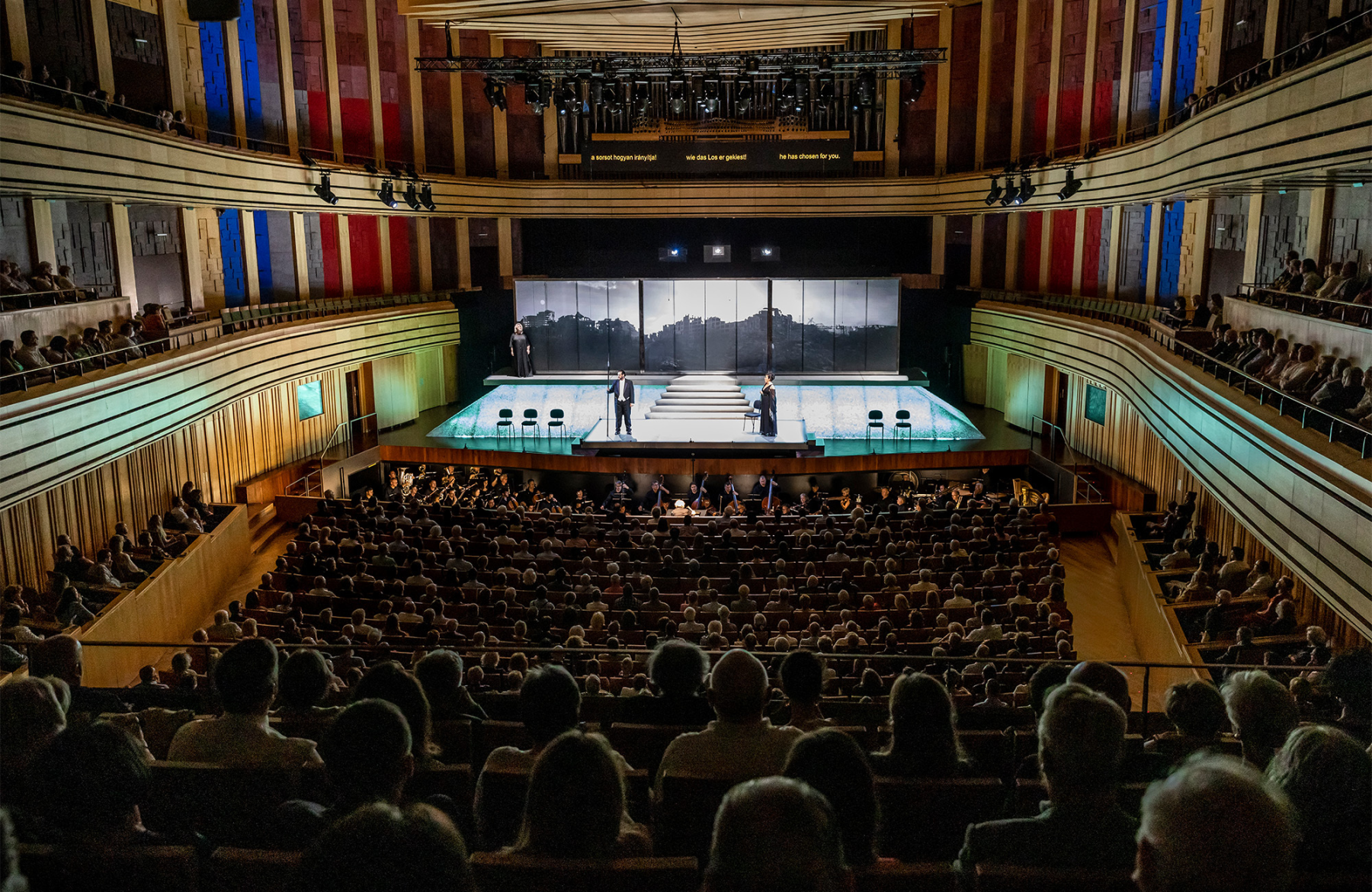
– ‘A work in progress’ is how you described your Müpa Budapest production of the Ring, which can now boast two decades of unbroken success, when the staging was being revamped in 2019. As Umberto Eco put it in his essay The Open Work: “In fact, the form of the work of art gains its aesthetic validity precisely in proportion to the number of different perspectives from which it can be viewed and understood.” By Eco’s criteria, the Müpa Ring is particularly valuable, as it is ‘open’ in every respect.
– My artistic credo embraces open dramaturgy. In previous interviews, I have described what I strive for: for anyone experiencing this Ring to project their own images into it. Some critics have accused me of being too specific, others have said the opposite… that’s the way it always is. In the years since we first presented the tetralogy at the then newly built Müpa Budapest, all of our lives have changed tremendously. An artist absorbs changes like a sponge. We now live in a much stricter social environment than we did before: it’s astonishing what our lives are like now. We have arrived in a multipolar world, one in which powerful forces are at work. Exactly in the same way as the Ring, with its gods, nibelungs and giants, itself puts powerful forces at odds with each other.
Right now, we are experiencing a kind of pivotal moment in history, and its social and political upheavals also present challenges in terms of artistic expression. It is essential that we respond to these developments both sensitively and with keen intuition.
Whenever I watch a production of the Ring, it always affects me in a different way. It’s the same music, and it touches me emotionally in the same way, but I always find a different film running in my head. It never ceases to fascinate me. And while the feelings are always similar, they still change. This makes it a great opportunity for us in the theatre world. At the same time, it is also a communal experience.
Codes or No Codes?
– Let’s talk about Wagner’s concept of the Gesamtkunstwerk, of ‘total art’. In an earlier interview, you said, “The special performance venue, and the presentation form that was specially developed for it, absolutely demand that the musical direction, production, setting and video design should be optimally coordinated.” At first, you seemed to emphasise the venue, the then brand new Müpa building, and then later the stress gradually shifted toward the ‘digital’ and dramaturgical aspects. How much further can this be abstracted, made even more conceptual, or more general?
– Giving the public some kind of code, even a digital one, in search of general validity is not a good direction to proceed in. I prefer to make use of the possibilities of references, I like to associate freely. And I would also like the audience to associate freely. That’s why, despite taking advantage of all the technical possibilities at our disposal, I would never go so far as to describe the end result as perfect. Especially because there is only a small step that separates the perfect from the museum-worthy. The concept of perfection is alien to me anyway, because it assumes a measurable base value that does not exist in art.
– Can this be understood to mean that it is not necessary to impose – at least not too directly – on the audience the image that takes shape in the director’s own mind during the staging process?
– If the production captivates the audience, they will inevitably start to associate. This inner cinema automatically continues to play in their heads. The work itself is the introduction, what starts this process. The ‘unambiguity’ of a work is the death of it.
– You must have seen a great many Ring productions around the world during your career. In your experience, to what extent have your counterparts left the doors open for these free associations?
– I’ve seen a few, although not so many. What bothers me most about them is that things become clear too quickly. In terms of aesthetics, I came of age in Brussels, during the Gerard Mortier era. It was there that I saw Herbert Wernicke’s amazing Ring. His staging dealt with the yearning for power that is evident throughout the tetralogy and its parallel with Hitler, that is, the Third Reich. This approach was endlessly straightforward, hard-hitting and simple, full of effective elements. While we could term this a historical approach, I find classifications – like traditional, historical, modern – troublesome… Why bother?
– These types of definitions are not really compatible with the openness of the work.
– Precisely. As a stage director and designer, I consider it important to lay down the tracks, not to unambiguously ‘premasticate’ everything into a pulp for the audience to consume.
– Listening to all this, one gets the sense that the story could be transferred to practically any environment.
– The field is wide open; of course you can do anything you like with it. However, my artistic credo insists that no idea of this nature should function as an end in itself. That is, it should not be implemented just for the sake of being different from familiar ideas. In the Salzburg Easter Festival’s production of Das Rheingold, director Kirill Serebrennikov took a completely new approach. The characters are all African, the stage depicts an ice-covered, largely desolate Africa, and the projections show a naked Alberich wandering restlessly through the frozen, post-apocalyptic landscapes. With all the dancers, extras, subplots, costume changes and constant movement, it was difficult to discern any specific message that would be necessary for the ‘laying down of the tracks’ I mentioned just now. Neither the African setting nor African myths have anything to do with Rheingold.
Myths
– Wagner considers myth to be an ideal raw material, one that can be reworked again and again until the usual, rationally explicable forms of human relations disappear from it. Emerging from them in a concrete form is the pure unity of humankind – which is what gives myths their unique character. Do you think it impossible for this African lineage to be incorporated into the process of the Ring myth?
– Myth embodies a world that is closed unto itself and is based on its own laws. It builds itself up over centuries before reaching us. I used mythological characters, starting with those in Rheingold, who become more and more human. By means of the projected videos, I very consciously aimed to immerse all of us in these myths by diving into the water, and then emerging from it at the end.
At the time of the Ring’s creation, Germany, which consisted of many small states, was searching for a sense of national unity and historical and linguistic roots, and thus came upon medieval Nordic mythology. This was accepted, and became the Germans’ own. This mythology can deliver its impact in many ways and environments, but an African setting like this is not one of them.
– In 2019, you said that “In comparison to the first version of the Ring, we developed an overall concept on the visual level which sweeps through all four parts. It is based on the four natural elements (water, fire, earth and air) which have a central significance in all pagan mythologies (which the Ring mythology also refers to). The myth itself as a fifth element is picked out as a theme.” This dramaturgical map may also be familiar from The Magic Flute – in a scene from Ingmar Bergman’s 1975 film version, Sarastro sits backstage, absorbed in reading the story of Parsifal. This is certainly more than just a good joke…
– It is obviously more than that, but it’s not a big sensation, either. The cultural circles surrounding the works of Mozart and Wagner share common roots, which can lead to similar consequences. And it is also true that, in the case of Mozart’s operas, their creation is connected to the life story of the composer and the circumstances of his era, and later interpretations must inevitably adapt to the circumstances of their own time.
The dramaturgy of Così fan tutte, for example, is completely open, as the story itself is timeless and could take place anywhere and in any era. In contrast, The Marriage of Figaro presents a constrained, closed dramaturgy, as the motor driving the plot is a privilege that no longer exists: jus primae noctis. How does this fit into the circumstances of today? How can this privilege be interpreted in our time? How can it be transplanted into today’s world? Should it be abandoned altogether? This represents a challenge for directors of any era…
Not a Company – Singers
– In order to keep a hybrid production like the Budapest Ring – which possesses characteristics of both a theatrical and concert hall version – alive for two decades with undivided success, flexible direction is needed not only from a dramaturgical and stage technology perspective, but also from a musical point of view. After all, there are always new performers arriving from abroad, in addition to new Hungarian ones.
– These options had to be built into the concept from the start. This is possible if the individual roles can accommodate multiple approaches without compromising the message, the overall effect. I’ll give you an example that has already affected the updated 2019 version. Once, instead of a majestic Brünnhilde, we had to sign someone else, and in the end we found almost the opposite, a defiant little child-like Brünnhilde. It was strange at first, but we used this new personality very well. An open staging must be able to tolerate different performance styles: realistic, abstract or sublime.
Hybrid Theatre
– When one singer with such a different persona appears in the production, it also impacts the others. You once said that “all this enriches the performance, multiplying the image of each character. When a different person from the one the day before sings Wotan or Siegfried, the other singers have to react to that, and new aspects always arise.” The Müpa Ring shines the spotlight on the singers. Is there a conceptual reason for this, or does it instead serve to counterbalance the non-traditional music drama environment?
– In an interview a few years ago – in Budapest, as it happens – I mentioned that I love going to concerts, and when I see a singer employing their face and eyes, then they have me right there. I value these moments much more than some grand concept being superimposed on an opera. If a singer stands up and starts incorporating their whole being into the performance, I think that is a magical moment. That’s what I want to show. I was here the first year and watched Parsifal, and I found this minimalist concept very interesting. I saw what Christian Franz was doing, and, to a certain extent, that was what showed me the way forward. He painted entire pictures with his voice and, within this framework, he produced truly grand opera. That was probably the most convincing thing. I didn’t want to pretend that we were performing opera on a concert stage. This limitation spurred my imagination. I wanted to return to the simplest forms of ancient Greek theatre, the orchestra and the stage, because I believed that expanding them with contemporary tools was in line with the spirit of Wagner’s concept of total art.
In an opera house, where there is all kinds of scenery, the singers have to perform much more theatrically than they do here. The entire space is completely different: the audience feels closer and much more attentive to every little movement on stage. The images, the visuals in the rear, cannot be more powerful than the singer in the front, but at the same time must, of course, be interesting. They must tell us something, while still allowing the singer to dominate.
With Ádám, and Later Without Him
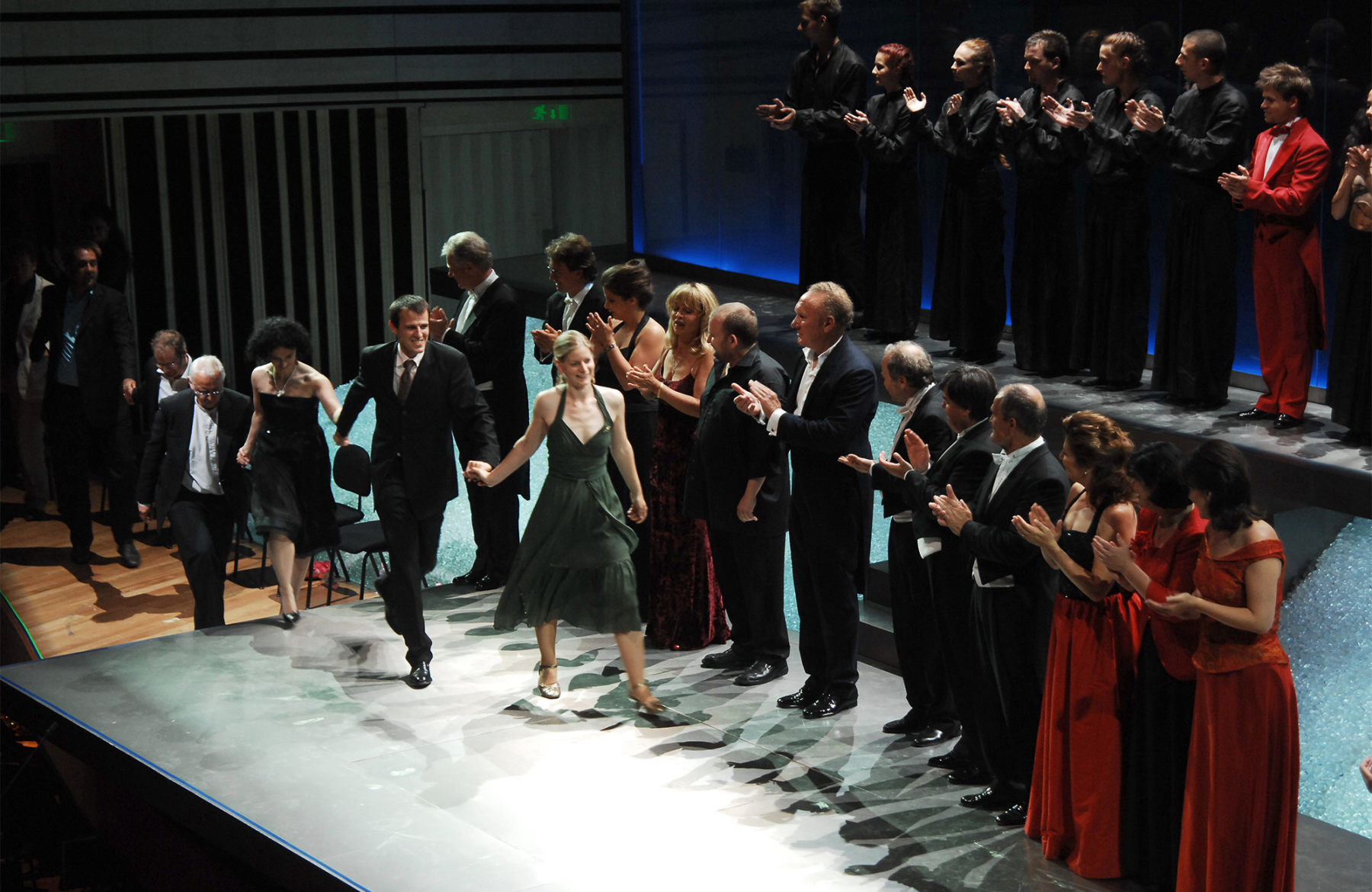
– In light of everything, the fact that this year will be Ádám Fischer’s last time conducting Ring at Müpa might be a particularly sensitive topic. What comes next?
– Good question. Ádám is the one who really brings the most to these performances. He’s a great partner, always able to work with the given situation. Off the top of my head, I can’t name any other conductor with such a close bond with the stage and the singers. I hope his successor in this production will work in a similar fashion. Something different happens on stage every night. The singers come bearing different burdens. Responding sensitively to this is what makes the performances so incredibly rich. This is one of the special features of the Budapest Ring. I’ve seen a lot of these performances, and there’s always something new happening. Everything is completely immersive: acoustically, visually and, of course, musically. All throughout, however, the focus remains on the singers. Having seen many performances of Wagner’s operas, including the Ring, I can say that I have never witnessed such absolute concentration on the singers anywhere else. It is entirely unique. There is no need for a magnifying glass. The video screen doesn’t swallow them up.
Most conductors are primarily concerned with the orchestra; what is happening on stage is important to them, but they don’t tend to react to every little thing. I hope that whoever comes next will follow the tiny vibrations on stage in the same way.
Today’s Ring tomorrow
– When you think about the future, about the technical possibilities of the future, is there anything you would like to incorporate into this production?
– Naturally, because there are already at least five issues that I would like to correct. I see the various points of view, and there are also many cost issues involved. I’d rather not give any specific examples at the moment, because in its current form this Ring can be considered a complete work.
Interview conducted by Anna Tóth