
Opening:
3 February 2017 / 7 pm
Venue: Banner Square
Exhibition opened by: Howard Mandel, President of the Jazz Journalists Association
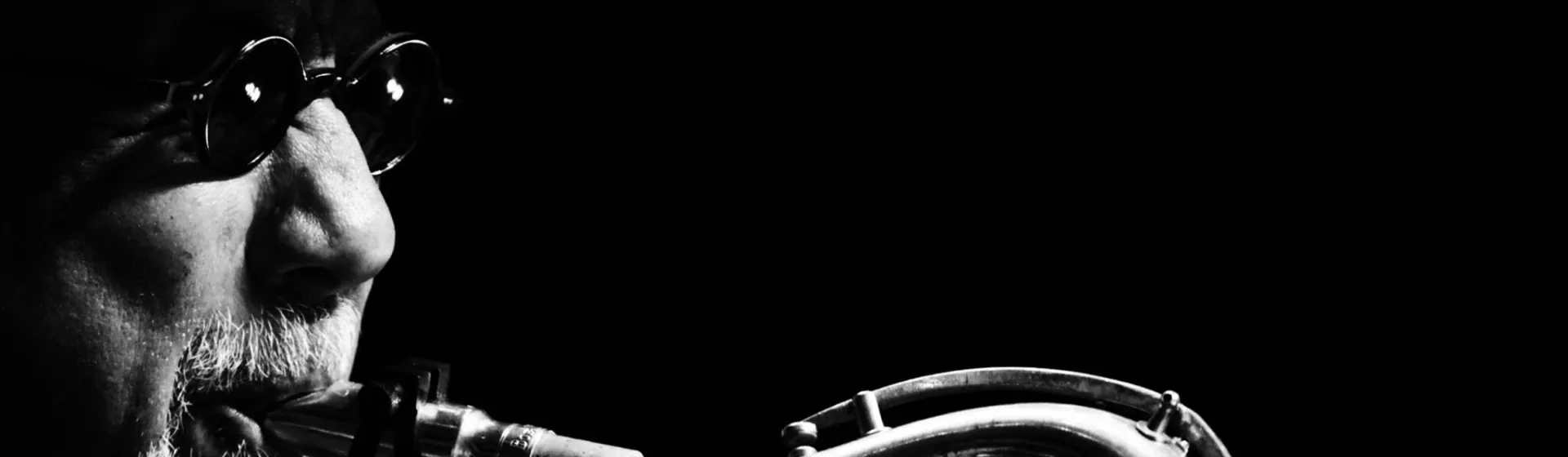
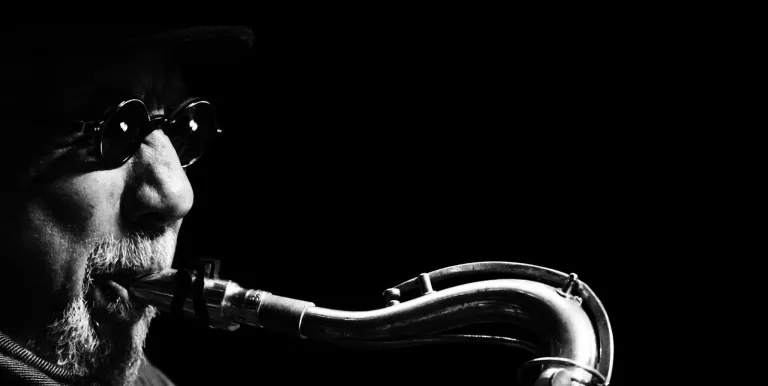
It takes a rare largesse of spirit for a young person not only to be touched by an art form that - in terms both of trendiness and profitability - is in a most lamentable state, but also to spare no effort - mental, physical or financial - to erect a permanent monument, in his own medium, to the greatest surviving members of that genre. And the portraits, just like the music of the artists they depict, make up a lasting monument indeed. Sánta's task was harder than the one facing his illustrious predecessors Herman Leonard, William Gottlieb, William Claxton, Val Wilmer and Gjon Mili, who were able to snap the giants of jazz at the height of their creative powers during the golden age of jazz. Back in the day, they didn’t have to venture further than New York's legendary 52nd Street. Sánta, on the other hand, had to wander from city to city, from club to club, to seek out those surviving giants who had made their lasting mark on that wonderful and unique music we call jazz. In order to immortalise his heroes, he visited 15 countries, travelling everywhere from Hong Kong to Montreux or to New York, often resorting to hitch-hiking and sleeping rough in parks or under a boat, or backstage in the artists' tent .
In terms of both their human and musical content, Sánta's portraits displayed here cast a very wide net. In artistic and social terms, one extreme is represented by one of the most intellectual and versatile figures in contemporary American jazz: composer and philosopher Anthony Braxton, who plays more than a dozen wind instruments in addition to the piano, or the founding father of free jazz, the piano virtuoso Cecil Taylor. The other extreme is personified by Quincy Jones, known not only as the one-time musical director and arranger for the globe-trotting Dizzy Gillespie Big Band, but also as a conductor, composer, television and film producer, magazine founder, record company executive and 27-time Grammy Award winner. While these artists don’t really need any introduction, not many people will remember Frank Wess, the marvellous flautist and sax-player of the so-called “New Testament” Basie band that had risen phoenix-like from its ashes in the 1950s. Wess is, sadly, no longer of this world, but he still remains with us in Csaba Sánta's photo gallery.
It may disappoint some feminists that only two women appear in this collection: the great 20th century innovator, pianist, composer and bandleader Carla Bley and the wonderful Amina Claudine Myers, who straddles the thin borderline between jazz and African-American sacred music. Jazz, regrettably, started off as a highly masculine art form and, apart from vocalists, women, at first, were only tolerated at the keyboard, and only infrequently at that. Nowadays there has been a welcome change in the situation, albeit a gradual one.
This exhibition displays the faces of musical heroes from the latter half of the last century who, with four exceptions, are still among the living, ranging from bebop 'vocalese” master, Jon Hendricks to Muhal Richard Abrams. But each one of the faces in Csaba Sánta's portraits serves as a map, the map of a life’s journey or that of artistic concentration.
Péter Pallai, former senior associate at the BBC World Service
Presented by:
-
Parking is free of charge for visitors with tickets to any of our paid performances on the day of the performance. Upon entering the car park, you can either scan the barcode or QR code on your concert ticket, or take a parking ticket and validate it together with your concert ticket at one of the payment machines. Either option will enable you to exit through the gates operated by the number plate recognition system. We recommend that you plan to arrive at Müpa in good time, so that you can find the ideal parking spot quickly and without difficulty and arrive at your performance comfortably. The detailed parking policy of Müpa Budapest is available here.