Digital programme booklet
-
Performed by:
dancers from the Hungarian National Dance Ensemble
Featuring:
amateur dancers from Szeged
Creators:
Director, choreographer: Zsuzsa Zs. Vincze, Zoltán Zsuráfszky
Costume designer: Zsuzsa Zs. Vincze
Music: Benjamin Eredics
Set designer: Kázmér Tóth
Visual design: János “Madár” Madarász -
The Kossuth Prize-winning creative duo of Zoltán Zsuráfszky and Zsuzsa Zs. Vincze has turned its attention to the many stormy centuries faced by the Hungarian people time and again. Once again, this will be no tedious history lesson: Requiem for Mohács explores how collective memory can be shaped into movement, music and images on stage. Mohács has, after all, long since meant more than the site of a lost battle. Over the centuries, it has become one of the Hungarian people’s most powerful symbols of defeat, of mourning and of subsequent starting anew – a symbol to which generations of poets and painters have repeatedly returned. The dance stage is an especially fitting place to explore all this since it makes the burden of history tangible through bodies, rhythms and collective forms.
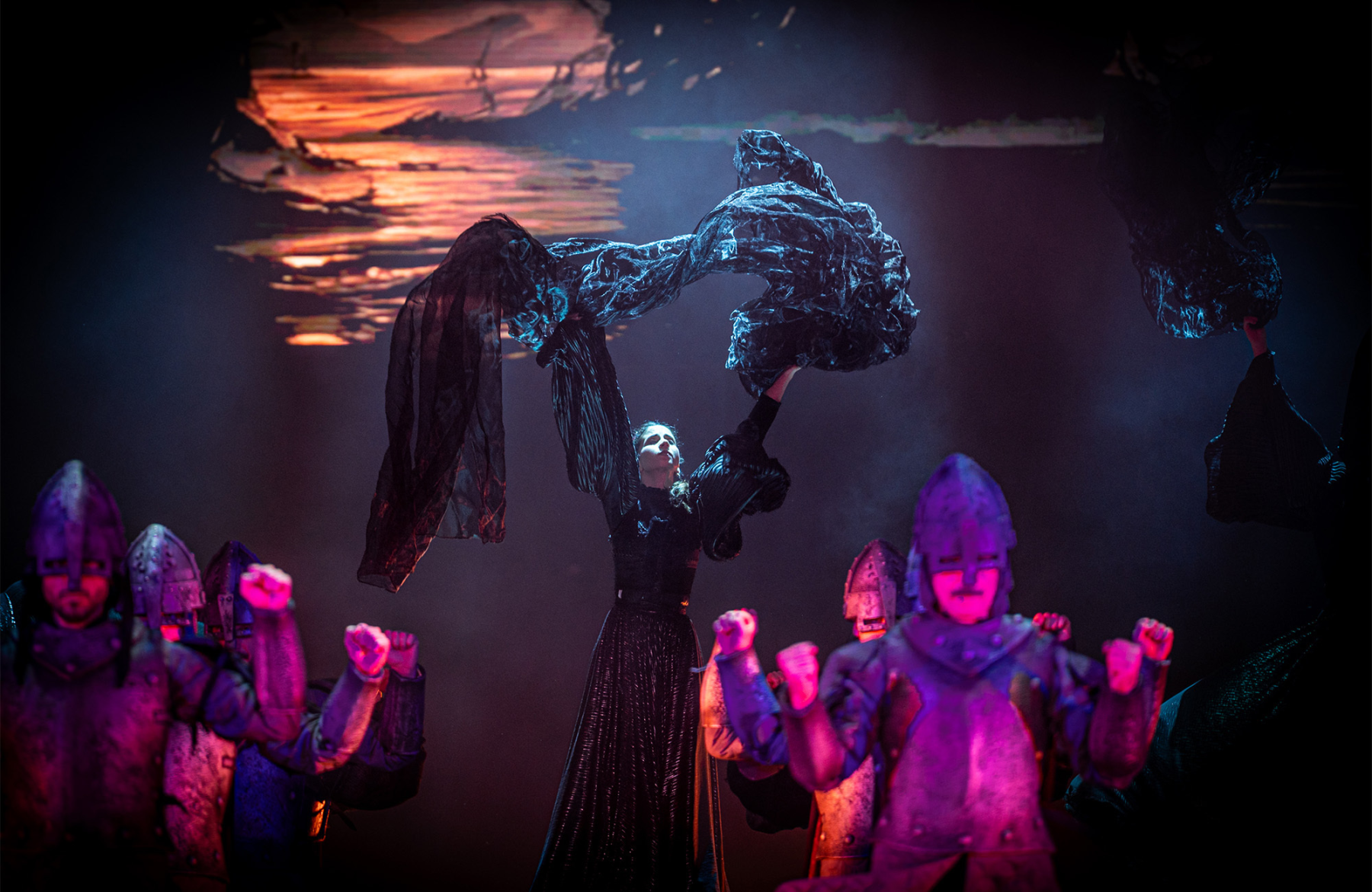
The work does not attempt a traditional, chronological reconstruction of the battle fought against the Turks in 1526. Hungarian warriors wait on the field of Mohács; from here begins a grand, visionary journey that leads through the symbols of national memory and successive historical eras. After images of the legendary past, later struggles, losses and new beginnings flash into view; verbunkos, recruiting dances, csárdás and other dance forms continue the sequence of images as we advance through time. History is not a series of successive lessons, but rather a network of associations in which the images of one age call forth those of the next.
Behind Requiem for Mohács lies a creative collaboration spanning several decades, in which choreography, dramaturgy, music and visual design are tightly interwoven. While the director-choreographer Zoltán Zsuráfszky has compiled the movement of the crowds and dramatic situations from his native language – the formal vocabulary of folk dance – Zsuzsa Zs. Vincze, as co-director, choreographer, scriptwriter and costume designer, has created the arc of the story and its visual world as it appears on stage. The music for the production was composed by Benjamin Eredics, a musician from the Söndörgő ensemble. For the Requiem, the creators sought music that would have historical weight while also delivering living stage power. Eredics’s composition lends rhythm and tension to the monumental historical vision.
At the end of the journey, we return to the tragic site of the battle in 1526. The circular structure offers a distinctive viewpoint: Mohács is at once a historical event and a point of memory from which later ages may also be contemplated – thus, at the heart of the work, defeat stands side by side with survival.
© Csilla Cseke
-
Performed by:
dancers from the Hungarian National Dance Ensemble
Featuring:
amateur dancers from Szeged
Creators:
Director, choreographer: Zsuzsa Zs. Vincze, Zoltán Zsuráfszky
Costume designer: Zsuzsa Zs. Vincze
Music: Benjamin Eredics
Set designer: Kázmér Tóth
Visual design: János “Madár” Madarász -
The Kossuth Prize-winning creative duo of Zoltán Zsuráfszky and Zsuzsa Zs. Vincze has turned its attention to the many stormy centuries faced by the Hungarian people time and again. Once again, this will be no tedious history lesson: Requiem for Mohács explores how collective memory can be shaped into movement, music and images on stage. Mohács has, after all, long since meant more than the site of a lost battle. Over the centuries, it has become one of the Hungarian people’s most powerful symbols of defeat, of mourning and of subsequent starting anew – a symbol to which generations of poets and painters have repeatedly returned. The dance stage is an especially fitting place to explore all this since it makes the burden of history tangible through bodies, rhythms and collective forms.
The work does not attempt a traditional, chronological reconstruction of the battle fought against the Turks in 1526. Hungarian warriors wait on the field of Mohács; from here begins a grand, visionary journey that leads through the symbols of national memory and successive historical eras. After images of the legendary past, later struggles, losses and new beginnings flash into view; verbunkos, recruiting dances, csárdás and other dance forms continue the sequence of images as we advance through time. History is not a series of successive lessons, but rather a network of associations in which the images of one age call forth those of the next.
Behind Requiem for Mohács lies a creative collaboration spanning several decades, in which choreography, dramaturgy, music and visual design are tightly interwoven. While the director-choreographer Zoltán Zsuráfszky has compiled the movement of the crowds and dramatic situations from his native language – the formal vocabulary of folk dance – Zsuzsa Zs. Vincze, as co-director, choreographer, scriptwriter and costume designer, has created the arc of the story and its visual world as it appears on stage. The music for the production was composed by Benjamin Eredics, a musician from the Söndörgő ensemble. For the Requiem, the creators sought music that would have historical weight while also delivering living stage power. Eredics’s composition lends rhythm and tension to the monumental historical vision.
At the end of the journey, we return to the tragic site of the battle in 1526. The circular structure offers a distinctive viewpoint: Mohács is at once a historical event and a point of memory from which later ages may also be contemplated – thus, at the heart of the work, defeat stands side by side with survival.
© Csilla Cseke